摘要
主要结论
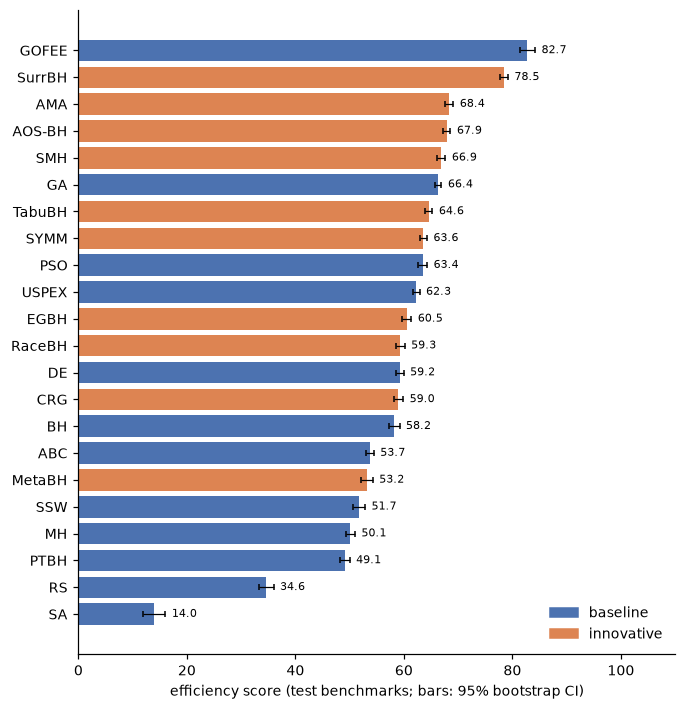
- GOFEE (Gaussian-process surrogate search) 排名第一(得分 82.7,95% 置信区间 [81.3, 84.2],在 100% 的 bootstrap 样本中第一),其后为 Online-surrogate pre-relaxation BH(78.5)、Adaptive memetic algorithm (GA + BH chains)(68.4)。
- 最佳创新算法 Online-surrogate pre-relaxation BH 对比最佳主流算法 GOFEE (Gaussian-process surrogate search):每发现一次全局最优所需离子步为后者的 1.34 倍(两者都解出的 39 个基准上的几何平均)。
- 10 个创新算法中有 0 个得分高于所有主流算法。
- 盆地跳跃(文献参数)排名第 15/22;第一名算法的效率是 BH 的 5.44 倍(两者都解出的基准上 ERT 比值的几何平均)。
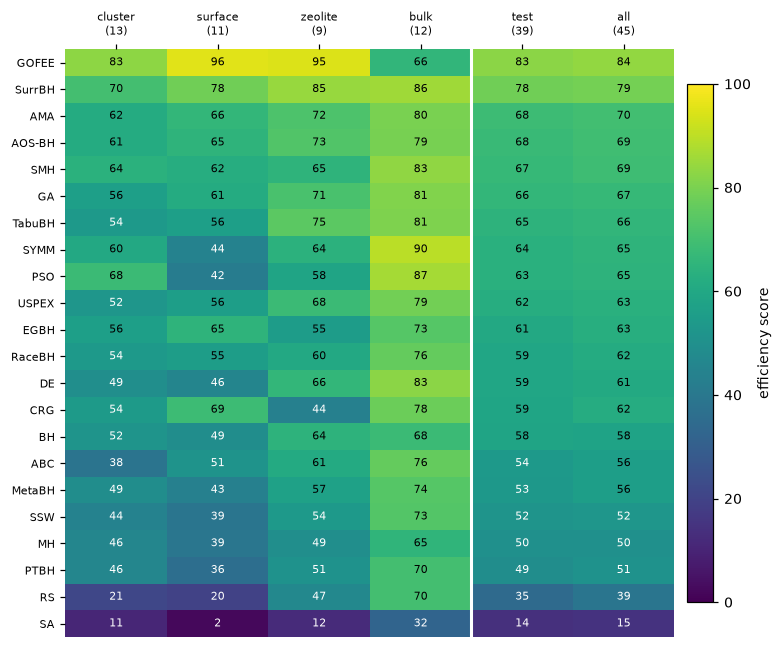
- 各类别第一:团簇——GOFEE (Gaussian-process surrogate search)(83);表面——GOFEE (Gaussian-process surrogate search)(96);分子筛——GOFEE (Gaussian-process surrogate search)(95);体相——Symmetry-seeded search(90)。
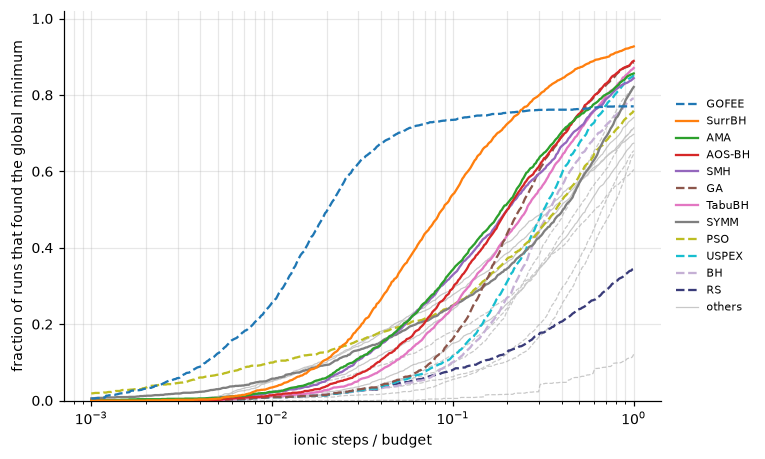
- 最稳健:Online-surrogate pre-relaxation BH 在 93% 的运行中找到全局最优,解出 39/39 个基准。
- 若以墙钟时间而非离子步计,最佳算法为 Adaptive operator selection basin hopping(得分 84.3)。
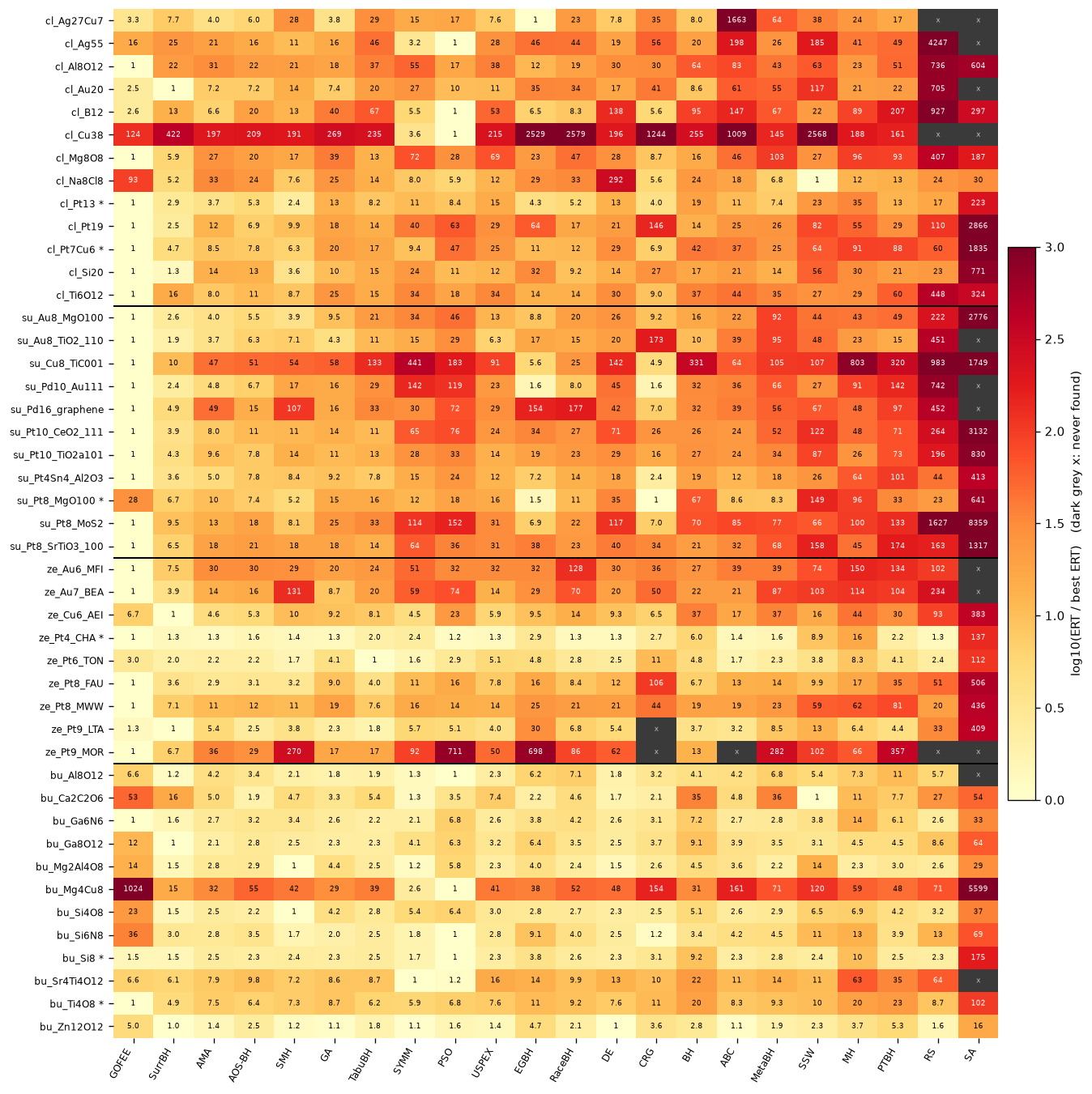
- 最难的基准:ze_Pt9_MOR(18/22 个算法解出)、cl_Ag27Cu7(20/22 个算法解出)、cl_Cu38(20/22 个算法解出)。
解读说明
- 运行次数与成本。“50 轮”指每个算法在每个基准上用 50 个独立随机种子各运行一次,每次运行都使用该基准的完整离子步预算。效率按离子步(对整个体系做一次 NEP89 能量+力计算)而不是按秒计算;另外单独给出按墙钟时间的得分。每次运行占用 NERSC Perlmutter 上 5 个节点(640 核)中的一个 CPU 核。
- 开发集与测试集。6 个开发基准(标 *)用于开发和调试新算法,不计入主得分。开发者还在所有基准上做过简短的崩溃测试(1 个种子),自适应模因算法的开发者在留出基准上做过 5 个种子的冒烟测试;这些运行只用于检查稳健性,但我们仍将其披露为可能的轻微测试信息泄漏。
- NEP89 不等于 DFT。参考结构是 NEP89 势能面上(guard 不起作用的结构中)的推定全局最优,其中若干与 DFT 或实验不同。由于本基准衡量的是在给定势能面上的搜索效率,我们保留这些结构:Si8(β-tin 型晶胞低于金刚石结构)、GaN(闪锌矿比纤锌矿低 33 meV/原子)、SiO2(ABW 型骨架低于 α-方石英和石英)、Si3N4(一种假想网络比 β-Si3N4 低 12 meV/原子)、CaCO3(球霰石型层状结构比方解石低 7 meV/原子)、MgAl2O4(反尖晶石)、TiO2(锐钛矿比金红石低 66 meV/原子)、Au20(低对称异构体而非 Td 四面体)、Pt19(空心笼)、B12(二十面体而非准平面结构)、(MgO)8(岩盐碎片而非环状笼)、以及 Au8/MgO(001) 与 Cu8/TiC(001) 的过度铺展。详见各基准说明。
- 负载与受限团簇。衬底为冻结的平板或骨架。NEP89 不含电荷转移,也未针对金属/氧化物或金属/分子筛界面拟合,因此结合能与位点偏好只具有定性意义。NEP89 会使 Pd、Pt 原子与 MFI 的 SiO4 棱成键(M–Si 2.4–2.5 Å),所以 MFI 中改用 Au 团簇。
- 容差。etol 一般为 0.02 eV;ze_Pt6_TON、ze_Pt8_MWW、ze_Pt9_LTA 为 0.01 eV,su_Au8_MgO100 为 0.015 eV(不同异构体间距小于 0.02 eV);cl_Na8Cl8 与 su_Pd16_graphene 为 0.05 eV(到达同一结构的运行能量分散超过 0.02 eV)。
- 伪影筛查。见方法部分:经专门的“空洞”搜寻后,对 6 个基准加强了 guard 设置;表面基准增加了真空势墙,使搜索原子留在平板顶面(对 Au8/TiO2(110),吸附到周期镜像冻结底面的结构能量偏低 1.4 eV);主实验结束后对每个排名第一的结构重新检查(重算能量、最短距离、guard 与势墙能量、连通性、密度),并计算了所有计为命中的结构的 guard 与势墙能量。由此在两个留出晶体 SiO2 与 SrTiO3 中发现了 guard 只使其变浅、但没有消除的 NEP89 空洞(49,500 次运行中有 20 次停在其中)。因此 Eref 取自 guard 不起作用的结构;把这 20 次运行计为失败也不改变排名(见方法)。基准的 guard 设置修改之前的运行带有不同的基准哈希,不用于确定 Eref。真空势墙没有改变基准哈希:它对所有已保存的表面结构严格为零,两个最终停在真空层另一侧的开发运行已被移除。
- 墙钟时间上限。两个代理模型算法(GOFEE 与 SurrBH)的大部分时间花在代理模型的训练和在代理模型上的弛豫上,因此每次运行限时 1 小时;达到上限前未命中的运行按全部预算计入步数,以免慢速算法在每离子步效率上显得更便宜;在上限前命中的运行照常计为命中。GOFEE 的 2,250 次运行中有 1,960 次达到上限(其中 1,500 次在此之前已命中,460 次未命中);SurrBH 没有运行达到上限。SurrBH 还会根据已用墙钟时间调整代理模型的工作量以便在上限内完成,因此其运行在其他硬件上不能逐位复现。其余算法的运行不设时间上限。
- 共享代码。所有算法使用同一个计算上下文、弛豫器与结构操作。主实验前对上下文做了修改:当晶胞基矢严重倾斜时,晶胞弛豫从 Minkowski 约化后的晶格开始(消除了体相搜索中虚假的弛豫中止);盆地跳跃改为按最近 10 次移动的接受率调整步长(与 GMIN 一致)。两项稳健性修正不影响正常运行:NEP89 计算失败(塌缩晶胞中近邻表溢出)时,该次计算记为一个能量极高的离子步而不再中止运行;共享的原子重定位操作在找不到位置时返回原结构。以下简化因各算法已据此调参而保留:共享的 cut-and-splice 交叉算子(GOFEE、AOS-BH 与 SurrBH 使用)把第二个亲本在三维上平移到第一个亲本的中心,这会使负载团簇的原子偏离吸附位点(GA 使用自己的算子);共享的原子重定位操作只把原子放到负载团簇的外壳上(不会直接放到衬底上);Maxwell–Boltzmann 速度函数去除的是未加权的平均速度而不是质心速度。
排名
排名依据是 39 个留出基准上的效率得分(新算法调参所用的 6 个开发基准不计入)。对每个基准,比较各算法的期望运行时间 ERT(每发现一次全局最优所需的离子步数)与该基准上最快算法:得分 = 100 × 平均[clip(1 + log10(ERTbest/ERT)/3, 0, 1)]。100 表示在所有基准上都最快;每慢 10 倍扣 33 分;未找到(或慢 ≥1000 倍)得 0 分。GMRE 为等价的几何平均相对效率(ERTbest/ERT)。方括号为 95% 区间(±1.96 倍 bootstrap 标准误,对种子重抽样)。点击表头可排序。
| # | 算法 | 类型 | 得分(留出集) | P(第一) | GMRE | 平均名次 | 解出基准数 | 总成功率 | 相对 BH 加速 | 得分(全部) | 得分(开发集) | 得分(墙钟) | 单步耗时/BH |
|---|---|---|---|---|---|---|---|---|---|---|---|---|---|
| 1 | GOFEE (Gaussian-process surrogate search) gofee | 主流 | 82.7 [81.3, 84.2] | 100% | 0.304 | 6.23 | 39/39 | 77% | ×5.44 | 83.9 | 91.0 | 41.3 | 165.19 |
| 2 | Online-surrogate pre-relaxation BH surr | 创新 | 78.5 [77.7, 79.2] | 0% | 0.226 | 4.13 | 39/39 | 93% | ×4.05 | 79.1 | 83.6 | 58.3 | 14.72 |
| 3 | Adaptive memetic algorithm (GA + BH chains) memetic | 创新 | 68.4 [67.6, 69.1] | 0% | 0.113 | 7.03 | 39/39 | 86% | ×2.02 | 69.7 | 78.4 | 84.1 | 1.08 |
| 4 | Adaptive operator selection basin hopping aosbh | 创新 | 67.9 [67.3, 68.6] | 0% | 0.109 | 7.23 | 39/39 | 89% | ×1.96 | 69.3 | 78.6 | 84.3 | 1.04 |
| 5 | Soft-mode guided hopping softmode | 创新 | 66.9 [66.2, 67.7] | 0% | 0.102 | 7.15 | 39/39 | 84% | ×1.82 | 68.9 | 81.8 | 82.3 | 1.12 |
| 6 | Genetic algorithm (cut-and-splice) ga | 主流 | 66.4 [65.8, 66.9] | 0% | 0.098 | 7.65 | 39/39 | 89% | ×1.76 | 67.1 | 72.1 | 82.9 | 1.03 |
| 7 | Tabu basin hopping tabu | 创新 | 64.6 [63.9, 65.3] | 0% | 0.086 | 8.33 | 39/39 | 87% | ×1.55 | 65.7 | 73.2 | 80.9 | 1.04 |
| 8 | Symmetry-seeded search symm | 创新 | 63.6 [62.9, 64.2] | 0% | 0.081 | 10.23 | 39/39 | 82% | ×1.45 | 65.1 | 75.2 | 79.4 | 1.07 |
| 9 | Particle swarm optimisation (CALYPSO) pso | 主流 | 63.4 [62.6, 64.3] | 0% | 0.080 | 11.41 | 39/39 | 76% | ×1.44 | 64.8 | 73.5 | 78.5 | 1.15 |
| 10 | USPEX evolutionary algorithm uspex | 主流 | 62.3 [61.7, 62.9] | 0% | 0.074 | 9.78 | 39/39 | 85% | ×1.32 | 63.5 | 71.4 | 78.3 | 1.06 |
| 11 | Energy-guided basin hopping egbh | 创新 | 60.5 [59.6, 61.4] | 0% | 0.065 | 12.18 | 39/39 | 71% | ×1.14 | 62.9 | 78.1 | 76.0 | 1.10 |
| 12 | Racing basin hopping race | 创新 | 59.3 [58.5, 60.1] | 0% | 0.060 | 11.87 | 39/39 | 74% | ×1.05 | 61.5 | 76.1 | 74.9 | 1.09 |
| 13 | Differential evolution de | 主流 | 59.2 [58.5, 60.0] | 0% | 0.060 | 10.83 | 39/39 | 82% | ×1.07 | 60.6 | 69.4 | 75.4 | 1.06 |
| 14 | Cut-and-regrow (learned-site growth) growth | 创新 | 59.0 [58.1, 59.9] | 0% | 0.059 | 11.27 | 37/39 | 70% | ×1.37 | 61.9 | 81.1 | 73.2 | 1.12 |
| 15 | Basin hopping bh | 主流 | 58.2 [57.2, 59.2] | 0% | 0.056 | 12.31 | 39/39 | 79% | ×1.00 | 58.0 | 56.9 | 75.1 | 1.00 |
| 16 | Artificial bee colony (ABCluster) abc | 主流 | 53.7 [53.0, 54.5] | 0% | 0.041 | 13.35 | 38/39 | 71% | ×0.80 | 56.2 | 72.4 | 68.9 | 1.05 |
| 17 | Metadynamics-biased basin hopping metabh | 创新 | 53.2 [52.1, 54.3] | 0% | 0.039 | 14.33 | 39/39 | 67% | ×0.71 | 55.9 | 73.3 | 69.8 | 1.02 |
| 18 | Stochastic surface walking ssw | 主流 | 51.7 [50.6, 52.8] | 0% | 0.036 | 15.21 | 39/39 | 61% | ×0.62 | 52.5 | 57.2 | 69.0 | 0.96 |
| 19 | Minima hopping mh | 主流 | 50.1 [49.3, 51.0] | 0% | 0.032 | 15.85 | 39/39 | 65% | ×0.57 | 50.1 | 50.0 | 67.9 | 0.94 |
| 20 | Parallel-tempering basin hopping ptbh | 主流 | 49.1 [48.2, 50.0] | 0% | 0.030 | 16.41 | 39/39 | 65% | ×0.53 | 50.9 | 63.0 | 66.0 | 0.99 |
| 21 | Random search rs | 主流 | 34.6 [33.3, 36.0] | 0% | 0.011 | 18.51 | 36/39 | 35% | ×0.22 | 39.0 | 67.8 | 49.1 | 1.08 |
| 22 | Simulated annealing (MD) sa | 主流 | 14.0 [11.9, 16.0] | 0% | 0.003 | 21.71 | 27/39 | 12% | ×0.05 | 14.7 | 19.2 | 24.2 | 0.89 |
效率矩阵
各算法 ERT 与该基准最佳 ERT 之比(1 = 最快;x = 所有运行都未找到全局最优)。行按类别分组,* 为开发基准;列按总排名排序。
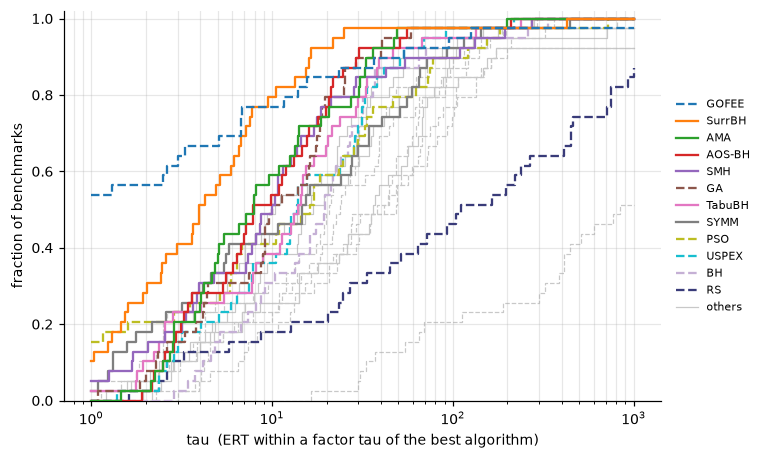
性能曲线
左:Dolan–Moré 性能曲线——算法 ERT 在最佳值 τ 倍以内的留出基准比例(τ=1 处为最快的频率,右端反映鲁棒性)。右:任意时刻性能——在消耗一定比例步数预算后已找到全局最优的留出运行比例(实线:创新算法,虚线:主流算法)。
分类排名
按基准类别计算的效率得分(包含该类别的开发基准;括号内为基准数)。
统计检验
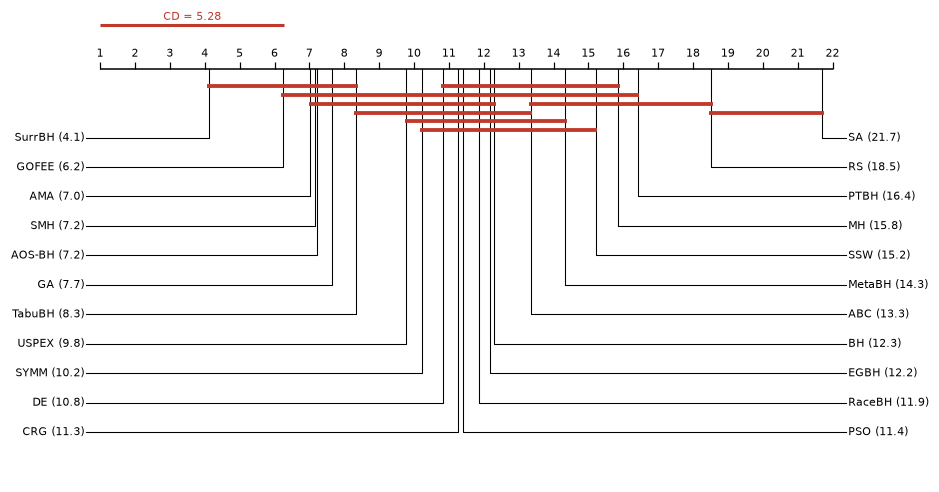
对留出集各基准 ERT 名次做 Friedman 检验:χ2 = 362.4,p = 5.2e-64,39 个基准,22 个算法。临界差异图(Nemenyi,α = 0.05):被红线连接的算法平均名次无显著差异。
对成功判据 etol 的敏感性
用不同的命中能量容差重新计算排名(同一批运行、同一 Eref)。Kendall τ 衡量与主排名得分顺序的一致性(1 = 顺序完全相同)。
| e_tol (eV) | Kendall τ | 前三名 |
|---|---|---|
| 0.02 (主排名) | 1.00 | GOFEE, SurrBH, AMA |
| 0.005 | 0.91 | GOFEE, SurrBH, AMA |
| 0.01 | 0.98 | GOFEE, SurrBH, AMA |
| 0.05 | 0.95 | GOFEE, SurrBH, AMA |
| 0.1 | 0.89 | GOFEE, SurrBH, AMA |
墙钟开销
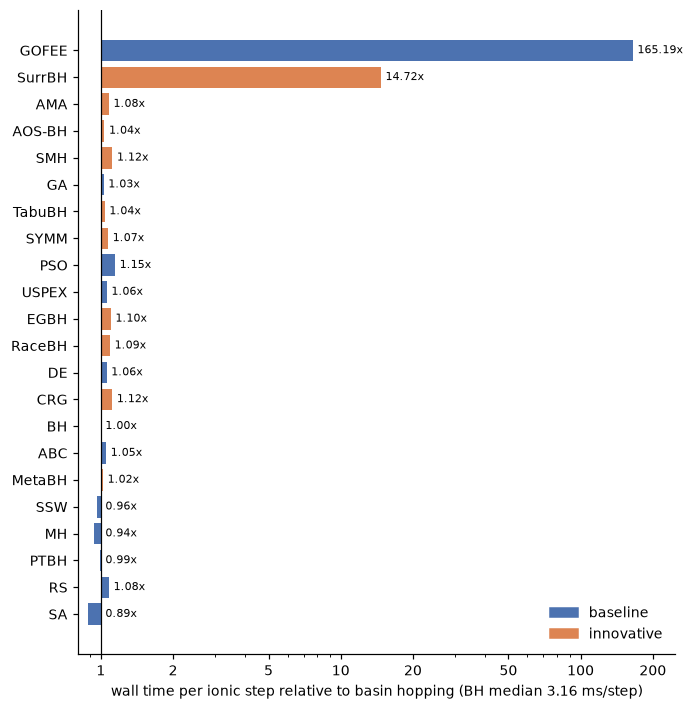
主要成本指标是离子步数。墙钟时间还包含算法自身开销(代理模型、指纹、种群管理等)。柱状图为各基准上单个离子步墙钟时间相对盆地跳跃(BH)的几何平均。排名表中“得分(墙钟)”一列是用秒计 ERT 重新计算的效率得分。
基准体系
Eref 为推定全局最优:所有算法所有运行(含开发阶段)在短程 guard 与表面势墙均不起作用的结构中找到的最低能量。†:发现了 guard 起作用的更低能量结构(NEP89 空洞),已排除(见方法)。dmin 比值:涉及搜索原子的最短距离除以共价半径之和(全局最优结构合理性检查)。
| 基准 | 类别 | 体系 | 原子数(搜索/总数) | 步数预算 | e_tol (eV) | E_ref (eV) | 最优发现者 | 最快算法 | 最佳 ERT | BH ERT | 解出算法数 | d_min 比值 |
|---|---|---|---|---|---|---|---|---|---|---|---|---|
| cl_Ag27Cu7 | 团簇 | Ag27Cu7 nanoalloy | 34/34 | 100,000 | 0.02 | -92.589 | gofee s3 (main) | EGBH | 2949 | 23.7k | 20/22 | 0.93 |
| cl_Ag55 | 团簇 | Ag55 cluster | 55/55 | 43,000 | 0.02 | -143.904 | gofee s5 (main) | PSO | 496 | 9714 | 21/22 | 0.93 |
| cl_Al8O12 | 团簇 | (Al2O3)4 cluster | 20/20 | 69,000 | 0.02 | -131.450 | surr s2 (main) | GOFEE | 731 | 46.8k | 22/22 | 0.91 |
| cl_Au20 | 团簇 | Au20 cluster | 20/20 | 55,000 | 0.02 | -54.218 | gofee s24 (main) | SurrBH | 1916 | 16.5k | 21/22 | 1.00 |
| cl_B12 | 团簇 | B12 cluster | 12/12 | 20,000 | 0.02 | -70.329 | gofee s0 (freeze-smoke) | PSO | 58 | 5531 | 22/22 | 1.03 |
| cl_Cu38 | 团簇 | Cu38 cluster | 38/38 | 150,000 | 0.02 | -124.470 | gofee s16 (main) | PSO | 1431 | 365k | 20/22 | 0.94 |
| cl_Mg8O8 | 团簇 | (MgO)8 cluster | 16/16 | 7,000 | 0.02 | -79.108 | gofee s10 (main) | GOFEE | 139 | 2226 | 22/22 | 0.94 |
| cl_Na8Cl8 | 团簇 | (NaCl)8 cluster | 16/16 | 84,000 | 0.05 | -46.392 | gofee s13 (main) | SSW | 2617 | 62.7k | 22/22 | 0.96 |
| cl_Pt13 * | 团簇 | Pt13 cluster | 13/13 | 20,000 | 0.02 | -60.512 | gofee s11 (main) | GOFEE | 81 | 1549 | 22/22 | 0.92 |
| cl_Pt19 | 团簇 | Pt19 cluster | 19/19 | 10,000 | 0.02 | -93.654 | softmode s9 (main) | GOFEE | 173 | 2422 | 22/22 | 0.93 |
| cl_Pt7Cu6 * | 团簇 | Pt7Cu6 cluster | 13/13 | 30,000 | 0.02 | -51.243 | gofee s9 (dev-gofee-v2) | GOFEE | 95 | 3955 | 22/22 | 0.91 |
| cl_Si20 | 团簇 | Si20 cluster | 20/20 | 34,000 | 0.02 | -97.221 | gofee s16 (main) | GOFEE | 342 | 5943 | 22/22 | 1.10 |
| cl_Ti6O12 | 团簇 | (TiO2)6 cluster | 18/18 | 47,500 | 0.02 | -153.068 | gofee s30 (main) | GOFEE | 422 | 15.6k | 22/22 | 0.75 |
| su_Au8_MgO100 | 表面 | Au8 / MgO(001) | 8/224 | 19,500 | 0.01 | -1304.467 | gofee s49 (main) | GOFEE | 345 | 5570 | 22/22 | 0.98 |
| su_Au8_TiO2_110 | 表面 | Au8 / rutile TiO2(110) | 8/332 | 37,000 | 0.02 | -2917.709 | gofee s11 (main) | GOFEE | 2016 | 20.6k | 21/22 | 0.91 |
| su_Cu8_TiC001 | 表面 | Cu8 / TiC(001) | 8/208 | 27,500 | 0.02 | -1896.129 | gofee s7 (main) | GOFEE | 47 | 15.5k | 22/22 | 0.91 |
| su_Pd10_Au111 | 表面 | Pd10 / Au(111) | 10/206 | 15,000 | 0.02 | -750.295 | gofee s13 (main) | GOFEE | 189 | 5995 | 21/22 | 0.98 |
| su_Pd16_graphene | 表面 | Pd16 / graphene | 16/144 | 12,500 | 0.05 | -1253.069 | gofee s5 (main) | GOFEE | 328 | 10.4k | 21/22 | 0.95 |
| su_Pt10_CeO2_111 | 表面 | Pt10 / CeO2(111) | 10/235 | 20,000 | 0.02 | -2015.337 | gofee s21 (main) | GOFEE | 316 | 8322 | 22/22 | 0.82 |
| su_Pt10_TiO2a101 | 表面 | Pt10 / anatase TiO2(101) | 10/226 | 21,500 | 0.02 | -1996.772 | gofee s38 (main) | GOFEE | 634 | 17.4k | 22/22 | 0.84 |
| su_Pt4Sn4_Al2O3 | 表面 | Pt4Sn4 / alpha-Al2O3(0001) | 8/248 | 15,500 | 0.02 | -1796.864 | gofee s36 (main) | GOFEE | 304 | 5840 | 22/22 | 0.95 |
| su_Pt8_MgO100 * | 表面 | Pt8 / MgO(001) | 8/152 | 30,000 | 0.02 | -903.441 | gofee s46 (main) | CRG | 371 | 24.8k | 22/22 | 0.98 |
| su_Pt8_MoS2 | 表面 | Pt8 / MoS2 monolayer | 8/116 | 27,500 | 0.02 | -853.724 | gofee s15 (main) | GOFEE | 163 | 11.5k | 22/22 | 0.95 |
| su_Pt8_SrTiO3_100 | 表面 | Pt8 / SrTiO3(001) | 8/168 | 13,000 | 0.02 | -1306.264 | gofee s48 (main) | GOFEE | 244 | 5101 | 22/22 | 0.88 |
| ze_Au6_MFI | 分子筛 | Au6 @ MFI (channel intersection) | 6/294 | 11,000 | 0.02 | -2275.943 | gofee s18 (main) | GOFEE | 275 | 7342 | 21/22 | 0.95 |
| ze_Au7_BEA | 分子筛 | Au7 @ BEA (channel intersection) | 7/199 | 12,000 | 0.02 | -1525.042 | gofee s21 (main) | GOFEE | 212 | 4574 | 21/22 | 0.96 |
| ze_Cu6_AEI | 分子筛 | Cu6 @ AEI | 6/150 | 16,700 | 0.02 | -1151.465 | gofee s45 (main) | SurrBH | 2160 | 80.4k | 22/22 | 0.92 |
| ze_Pt4_CHA * | 分子筛 | Pt4 @ CHA | 4/112 | 20,000 | 0.02 | -868.009 | gofee s38 (main) | GOFEE | 91 | 541 | 22/22 | 0.91 |
| ze_Pt6_TON | 分子筛 | Pt6 @ TON | 6/222 | 17,900 | 0.01 | -1726.858 | gofee s21 (main) | TabuBH | 7998 | 38.5k | 22/22 | 0.92 |
| ze_Pt8_FAU | 分子筛 | Pt8 @ FAU (supercage) | 8/152 | 12,000 | 0.02 | -1174.364 | gofee s30 (main) | GOFEE | 581 | 3886 | 22/22 | 0.92 |
| ze_Pt8_MWW | 分子筛 | Pt8 @ MWW | 8/224 | 5,300 | 0.01 | -1735.795 | gofee s40 (main) | GOFEE | 202 | 3919 | 22/22 | 0.94 |
| ze_Pt9_LTA | 分子筛 | Pt9 @ LTA (alpha cage) | 9/153 | 41,000 | 0.01 | -1175.253 | gofee s30 (main) | SurrBH | 4976 | 18.4k | 21/22 | 0.93 |
| ze_Pt9_MOR | 分子筛 | Pt9 @ MOR | 9/153 | 13,900 | 0.02 | -1173.951 | surr s15 (main) | GOFEE | 484 | 6427 | 18/22 | 0.91 |
| bu_Al8O12 | 体相 | Al2O3 (Al8O12) crystal | 20/20 | 10,000 | 0.02 | -152.733 | surr s31 (main) | PSO | 4834 | 19.9k | 21/22 | 0.99 |
| bu_Ca2C2O6 | 体相 | CaCO3 (Ca2C2O6) crystal | 10/10 | 100,000 | 0.02 | -75.385 | surr s40 (main) | SSW | 45.4k | 1612k | 22/22 | 0.91 |
| bu_Ga6N6 | 体相 | GaN (Ga6N6) crystal | 12/12 | 10,000 | 0.02 | -73.423 | gofee s18 (main) | GOFEE | 158 | 1142 | 22/22 | 1.01 |
| bu_Ga8O12 | 体相 | Ga2O3 (Ga8O12) crystal | 20/20 | 32,000 | 0.02 | -122.997 | softmode s36 (main) | SurrBH | 4902 | 44.5k | 22/22 | 0.98 |
| bu_Mg2Al4O8 | 体相 | MgAl2O4 spinel (Mg2Al4O8) crystal | 14/14 | 28,000 | 0.02 | -101.208 | bh s7 (pilot-bbu2-v4) | SMH | 23.5k | 106k | 22/22 | 0.96 |
| bu_Mg4Cu8 | 体相 | MgCu2 (Mg4Cu8) Laves-phase crystal | 12/12 | 60,000 | 0.02 | -43.194 | pso s44 (main) | PSO | 528 | 16.3k | 22/22 | 0.93 |
| bu_Si4O8 | 体相 | SiO2 (Si4O8) crystal | 12/12 | 43,000 | 0.02 | -94.588 † | softmode s41 (main) | SMH | 5896 | 30.1k | 22/22 | 0.92 |
| bu_Si6N8 | 体相 | Si3N4 (Si6N8) crystal | 14/14 | 88,000 | 0.02 | -117.299 | pso s42 (main) | PSO | 8579 | 29.0k | 22/22 | 0.95 |
| bu_Si8 * | 体相 | Si8 crystal | 8/8 | 20,000 | 0.02 | -44.116 | pso s7 (dev-pso-final) | PSO | 57 | 525 | 22/22 | 1.11 |
| bu_Sr4Ti4O12 | 体相 | SrTiO3 (Sr4Ti4O12) crystal | 20/20 | 22,000 | 0.02 | -163.984 † | pso s39 (main) | SYMM | 1351 | 30.2k | 21/22 | 0.87 |
| bu_Ti4O8 * | 体相 | TiO2 (Ti4O8) crystal | 12/12 | 30,000 | 0.02 | -109.891 | surr s0 (dev-surr-v4) | GOFEE | 186 | 3701 | 22/22 | 0.86 |
| bu_Zn12O12 | 体相 | ZnO (Zn12O12) crystal | 24/24 | 20,000 | 0.02 | -106.397 | softmode s49 (main) | DE | 2945 | 8329 | 22/22 | 1.05 |
基准描述与文献背景(点击展开;描述为英文)
- cl_Ag27Cu7 – Ag27Cu7 nanoalloy. Gas-phase Ag27Cu7 nanoalloy (geometry plus homotop / chemical-ordering search). With the Gupta potential the GM is a perfect core-shell polyicosahedron (pIh7, D5h) with a Cu7 pentagonal-bipyramid core under a 27-atom Ag shell (Rossi et al., PRL 93, 105503 (2004)); NEP89 reproduces this structure.
- cl_Ag55 – Ag55 cluster. Gas-phase Ag55. The Mackay icosahedron is the GM for many-body potentials (Cambridge Cluster Database) and is supported by DFT and photoelectron spectra of Ag55- (Haekkinen et al., PRL 93, 093401 (2004)). NEP89 reproduces it, about 2 eV below the cuboctahedron and Ino decahedron; the difficulty is the size of the landscape rather than near-degenerate competitors.
- cl_Al8O12 – (Al2O3)4 cluster. Gas-phase (Al2O3)4, an alumina dust-nucleation and gas-phase IR target; DFT global minima of small (Al2O3)n are compact cages of 4-membered Al2O2 and 6-membered Al3O3 rings with 3-5-fold Al and 2-4-fold O (Rahane, Deshpande & Kumar, JPCC 115, 18111 (2011)), and for n = 4 the B3LYP GM is a low-symmetry (C1) cage while PBE0 prefers a D3d isomer (Gobrecht et al., A&A 658, A167 (2022)). The NEP89 putative GM has these features (Cs cage; five 3-fold and three 4-fold Al; ten 2-fold, one 3-fold and one 4-fold O; two Al2O2 and eight Al3O3 rings; Al-O 1.71-1.98 Å; no O-O or Al-Al bonds), but its identity with the DFT GM was not verified. A Cs isomer 0.20 eV higher (one 2-fold Al) forms a competing funnel that traps some basin-hopping runs. Artefact screening: NEP89 has an O-O bonded hole; a particle-swarm run found a cage with O-O 1.11 and 1.22 Å, Al-O 1.53 Å and only 5-fold Al, 0.08 eV below the physical minimum. An O-O guard floor of 1.9 Å (guard_pairs; the shortest physical O-O distance here is 2.49 Å) lifts it by 41 eV and leaves the physical minima unchanged. [guard f = 0.75, O-O floor 1.9 A]
- cl_Au20 – Au20 cluster. Gas-phase Au20. DFT and photoelectron spectroscopy give a tetrahedral (Td) pyramid, a 20-atom fcc fragment (Li, Li, Zhai & Wang, Science 299, 864 (2003)). NEP89 instead prefers a low-symmetry structure with one interior atom; the relaxed Td pyramid is 0.11 eV higher.
- cl_B12 – B12 cluster. Gas-phase B12. Photoelectron spectroscopy and ab initio calculations establish a quasi-planar C3v global minimum (Zhai et al., Nat. Mater. 2, 827 (2003)), with 3D isomers such as the icosahedron several eV higher. NEP89 reverses this ordering: its putative GM is the Ih icosahedron (B-B 1.73 Å, the building block of bulk boron), 2.7 eV below the relaxed quasi-planar C3v structure, so this benchmark probes search on the NEP89 landscape rather than boron-cluster chemistry.
- cl_Cu38 – Cu38 cluster. Gas-phase Cu38. For many-body potentials (Gupta, Sutton-Chen) the GM is the Oh fcc truncated octahedron, separated from icosahedral/decahedral structures as in the LJ38 double funnel (Doye & Wales, New J. Chem. 22, 733 (1998); Cambridge Cluster Database). NEP89 agrees; the best non-fcc structure found lies 0.11 eV higher.
- cl_Mg8O8 – (MgO)8 cluster. Gas-phase (MgO)8. IR spectroscopy combined with DFT global optimisation (Haertelt et al., PCCP 14, 2849 (2012)) assigns cage-like structures containing hexagonal (MgO)3 rings, not rocksalt cuboids, to (MgO)n with n != 3k. NEP89 instead favours rocksalt fragments: its putative GM (a 3×3×2 rocksalt slab missing one corner MgO pair; Mg 3-5-fold coordinated, Mg-O 1.94-2.31 Å, no O-O or Mg-Mg bonds) lies 0.25 eV below the 2×2×4 cuboid and 2.7 eV below a hand-built hexagonal-ring cage.
- cl_Na8Cl8 – (NaCl)8 cluster. Gas-phase (NaCl)8. Small alkali-halide clusters adopt rocksalt-cuboid structures in ab initio and Tosi-Fumi studies (Aguado et al., PRB 56, 15353 (1997); Doye & Wales, PRB 59, 2292 (1999)), and the NEP89 putative GM is the 2×2×4 rocksalt cuboid (Na-Cl 2.56-2.65 Å). The landscape is soft: fmax = 0.05 relaxations of the same GM differ by up to 0.016 eV (0.3 meV after tight relaxation), hence etol = 0.05 eV.
- cl_Pt13 – Pt13 cluster. Gas-phase Pt13.
- cl_Pt19 – Pt19 cluster. Gas-phase Pt19. PBE and hybrid DFT give a Pt18 three-layer trigonal prism capped on a triangular face (C3v; Kumar & Kawazoe, PRB 77, 205418 (2008); J. Mol. Model. (2024), doi:10.1007/s00894-024-06099-5). NEP89 instead prefers a hollow 19-vertex deltahedral cage (all atoms 5- or 6-coordinated, Pt-Pt 2.53-2.57 Å), 1.5 eV below the relaxed DFT structure and 0.66 eV below the fcc octahedron, so this landscape is NEP89-specific.
- cl_Pt7Cu6 – Pt7Cu6 cluster. Gas-phase bimetallic Pt7Cu6 nanoalloy (13 atoms): geometric and homotop (chemical ordering) search.
- cl_Si20 – Si20 cluster. Gas-phase Si20. Ion-mobility measurements and DFT show prolate Sin clusters built from stacked tricapped-trigonal-prism units up to n ~ 25, with compact isomers close in energy around n = 20 (Ho et al., Nature 392, 582 (1998)). NEP89 has two near-degenerate putative minima, a compact oblate GM and a prolate isomer only 2 meV higher (tight relaxation), both with 4-7-fold coordinated Si and Si-Si ≥ 2.41 Å, so a hit (E ≤ Ebest + etol) can be either isomer.
- cl_Ti6O12 – (TiO2)6 cluster. Gas-phase (TiO2)6, a standard titania-nanocluster global-optimisation target; DFT global minima of small (TiO2)n are compact, with 4-/5-fold coordinated Ti and one or two terminal Ti=O groups (Qu & Kroes, JPCB 110, 8998 (2006); Lamiel-Garcia et al., Nanoscale 9, 1049 (2017)). The NEP89 putative GM has these features (two titanyl O at 1.69 Å, four 4- and two 5-fold Ti, nine 4-membered Ti2O2 rings, no O-O bonds), but its identity with the DFT GM was not verified; the default repulsive guard (Ti-O r0 = 1.695 Å) is marginally active on the titanyl bonds (0.3 meV).
- su_Au8_MgO100 – Au8 / MgO(001). Au8 on a frozen 3-layer MgO(001) slab (6×6 primitive surface cells, 216 atoms; NEP89 a = 4.203 Å vs exp. 4.212 Å), the classic model of size-selected Aun/MgO catalysts (Ricci et al., Phys. Rev. Lett. 97, 036106 (2006)). The NEP89 putative GM is a flat Au8 island with all 8 Au in contact with the surface (Au-Au 2.74-2.83 Å); NEP89 puts single Au atoms on top of O as DFT does, but places the best 3D isomers found (fcc 6+2 bilayers) ≥ 0.69 eV above the flat GM, whereas DFT finds 3D Au8 on bulk MgO(001) and planar Au8 only on metal-supported MgO films that charge the cluster (Ricci et al. 2006), i.e. NEP89 over-stabilises wetting. etol is 0.015 eV because distinct flat isomers lie 0.019 eV above the GM.
- su_Au8_TiO2_110 – Au8 / rutile TiO2(110). Au8 on a frozen 3-trilayer stoichiometric rutile TiO2(110) slab (3×6 cell, 19.5 × 17.7 Å, 324 atoms; NEP89 a = 4.606 Å, c = 2.957 Å vs exp. 4.594, 2.959 Å), the model support of Au/TiO2 CO-oxidation catalysts (Valden, Lai and Goodman, Science 281, 1647 (1998)). The NEP89 putative GM is a compact 3D Au8 with 5 Au in contact, 3 on the bridging-O row (Au-O 2.20 Å) and 2 atop 5-fold Ti in the trough (Au-Ti 2.68 Å); DFT likewise finds small Aun turning 3D on stoichiometric TiO2(110) (Au7) but binds them mainly through bridging and in-plane O (Chretien and Metiu, J. Chem. Phys. 127, 084704 (2007)), whereas NEP89 also favours Au-Ti5c contacts (a single Au sits atop Ti5c). The stoichiometric frozen slab lacks the O vacancies that anchor Au in experiment.
- su_Cu8_TiC001 – Cu8 / TiC(001). Cu8 on a frozen 4-layer TiC(001) slab (5×5 primitive cells, 200 atoms; NEP89 a = 4.285 Å vs exp. 4.328 Å), a model of Cu/TiC(001) catalysts for CO2 hydrogenation to methanol (Vidal et al., J. Phys. Chem. Lett. 3, 2275 (2012)). The NEP89 putative GM is a flat Cu8 island with every Cu on a top-C site (Cu-C 1.95 Å), the adatom site found by DFT (Gomez et al., J. Phys. Chem. C 114, 1622 (2010)); DFT places the 2D-to-3D crossover at Cu7 and finds a Cu6+2 bilayer for Cu8 (Li et al., ACS Omega 6, 27259 (2021)), which NEP89 puts 0.55 eV above its flat GM, i.e. NEP89 over-stabilises wetting.
- su_Pd10_Au111 – Pd10 / Au(111). Pd10 on a frozen 4-layer Au(111) slab (7×7, 196 Au; NEP89 a(Au) = 4.111 Å vs exp. 4.078 Å), a model of Pd-Au bimetallic catalysts and PdAu(111) surface alloys (Maroun et al., Science 293, 1811 (2001); Chen et al., Science 310, 291 (2005)). The NEP89 putative GM is a flat Pd10 island with every Pd in an fcc hollow (the same island in hcp hollows is 0.24 eV higher), in line with the 2D close-packed Pd islands seen by STM on Au(111) (Casari et al., Phys. Rev. B 79, 195402 (2009)); the frozen substrate excludes the Pd-Au place exchange (surface alloying) observed at room temperature.
- su_Pd16_graphene – Pd16 / graphene. Pd16 on frozen graphene (8×8, 128 C; NEP89 a = 2.476 Å vs exp. 2.461 Å), a model of graphene-supported Pd catalysts; DFT finds Pd clusters on graphene to be 3D from Pd4 on, because Pd-Pd bonding dominates the weak Pd-graphene interaction (Cabria et al., Phys. Rev. B 81, 035403 (2010)). The NEP89 putative GM is a Pd13 icosahedron with three capping atoms that touches graphene with a single vertex atom above a C6 hollow (Pd-C 2.39 Å); other capping isomers and orientations lie within 0.031 eV (next family +0.074 eV) and runs that reached the GM structure differ by up to 0.024 eV, hence etol = 0.05 eV.
- su_Pt10_CeO2_111 – Pt10 / CeO2(111). Pt10 on a frozen O-terminated CeO2(111) slab (3 O-Ce-O trilayers, 5×5 cell, 225 atoms; NEP89 a = 5.438 Å vs exp. 5.411 Å), a model of Pt/ceria oxidation and three-way catalysts. The NEP89 putative GM is a 3D Pt7+3 bilayer bound to surface O (Pt-O 1.99 Å), and NEP89 Pt8 is planar, in line with the DFT 2D-to-3D transition above Pt8 for PtN on CeO2(111) (Paz-Borbon et al., Phys. Chem. Chem. Phys. 19, 17845 (2017)). NEP89 is charge-neutral: the Pt-to-ceria electron transfer and Ce4+ → Ce3+ reduction found by DFT are not described, and the frozen slab excludes O spillover and vacancy formation.
- su_Pt10_TiO2a101 – Pt10 / anatase TiO2(101). Pt10 on a frozen 3-layer stoichiometric anatase TiO2(101) slab (oblique 15.2 × 15.3 Å cell, 216 atoms; NEP89 a = 3.819 Å, c = 9.296 Å vs exp. 3.785, 9.514 Å), the majority facet of anatase-supported Pt photo- and thermal catalysts. The NEP89 putative GM is a 3D Pt5+5 bilayer anchored on the terrace by 5-fold Ti (Pt-Ti 2.49-2.65 Å) and 2-fold O (Pt-O 2.09 Å), consistent with the strong Pt binding on anatase(101) terraces found by DFT and STM (Gong et al., J. Am. Chem. Soc. 130, 370 (2008)). Caveats: NEP89 Pt-Ti contacts are short (2.76 Å in Pt3Ti), NEP89 is charge-neutral and its anatase c axis is 2.3% too short.
- su_Pt4Sn4_Al2O3 – Pt4Sn4 / alpha-Al2O3(0001). Pt4Sn4 on a frozen Al-terminated alpha-Al2O3(0001) slab ((2sqrt3 × 2sqrt3)R30, Al96O144; NEP89 a/c = 4.753/12.895 Å vs exp. 4.759/12.991 Å), a model of Pt-Sn/Al2O3 propane-dehydrogenation catalysts (sub-nanometre Pt and PtSn clusters on alumina: Baxter et al., ACS Catal. 7, 3322 (2017); Liu et al., ACS Catal. 13, 2802 (2023)). In the NEP89 putative GM the oxophilic Sn atoms bind surface O (Sn-O 2.37-2.55 Å) and carry the Pt atoms on top (only Pt-Sn and Pt-Pt bonds, no Sn-Sn); note that NEP89 relaxes the surface Al 0.4 Å below the top O plane (DFT: about 0.1 Å above).
- su_Pt8_MgO100 – Pt8 / MgO(001). Pt8 cluster on a frozen 4-layer MgO(001) slab (3×3 conventional cells, 144 atoms).
- su_Pt8_MoS2 – Pt8 / MoS2 monolayer. Pt8 on a frozen 1H-MoS2 monolayer (6×6, 108 atoms; NEP89 a = 3.150 Å vs exp. 3.160 Å), a model of Pt/MoS2 catalysts; DFT finds that Ptn clusters on the MoS2 basal plane become 3D from n = 5 and that Pt particles bind to S (Saidi, Cryst. Growth Des. 15, 642 (2015)). The NEP89 putative GM is a 3D 5+3 Pt bilayer whose five lower Pt sit above Mo atoms, each bonded to three S (Pt-S 2.31-2.35 Å, Pt-Pt 2.58-2.60 Å); the lowest competing isomer, a 4+4 bilayer, is 0.16 eV higher.
- su_Pt8_SrTiO3_100 – Pt8 / SrTiO3(001). Pt8 on a frozen TiO2-terminated SrTiO3(001) slab (SrO/TiO2/SrO/TiO2, 4×4 cell, 160 atoms; NEP89 a = 3.908 Å vs exp. 3.905 Å), a model of Pt/SrTiO3 photocatalysts and perovskite-supported Pt. The NEP89 putative GM is a single buckled Pt8 layer (6 Pt on the surface, Pt-O 2.19 Å, Pt-Ti 2.61 Å; 2 Pt 1.7 Å higher), in line with DFT, which finds the TiO2 termination favourable for epitaxial Pt(100) films (Asthagiri and Sholl, J. Chem. Phys. 116, 9914 (2002)). NEP89 is charge-neutral and the frozen, unreconstructed slab excludes the surface reconstructions and O vacancies of real SrTiO3(001).
- ze_Au6_MFI – Au6 @ MFI (channel intersection). Au6 cluster at the intersection of the straight and sinusoidal 10-ring channels of a frozen all-silica MFI framework (silicalite-1; NEP89-relaxed orthorhombic cell, 288 framework atoms). Metal clusters encapsulated in MFI resist sintering (Goel, Zones and Iglesia, J. Am. Chem. Soc. 136, 15280 (2014)); for Au clusters in zeolites see Otto, Zones and Iglesia, J. Catal. 339, 195 (2016). Caveat: NEP89 is not fitted to metal/zeolite interfaces and the framework is rigid, so cluster-wall binding is qualitative (NEP89 GM: buckled Au6 anchored to the intersection wall); Au replaces Pd because NEP89 bonds Pd and Pt atoms to SiO4 edges of MFI (M-Si 2.4-2.5 Å).
- ze_Au7_BEA – Au7 @ BEA (channel intersection). Au7 cluster at an intersection of the 12-ring channels of a frozen all-silica zeolite beta (polymorph A; NEP89-relaxed tetragonal cell, 192 framework atoms). Metal clusters immobilised inside beta crystals resist sintering (Wang et al., Nat. Catal. 1, 540 (2018)). Caveat: NEP89 is not fitted to metal/zeolite interfaces and the framework is rigid, so cluster-wall binding is qualitative (NEP89 GM: planar Au7 spanning the intersection).
- ze_Cu6_AEI – Cu6 @ AEI. Cu6 cluster in the pear-shaped aei cage (8-ring windows, 3.8 Å) of a frozen all-silica AEI (SSZ-39) framework (NEP89-relaxed conventional cell, 144 atoms); Cu-SSZ-39 is a hydrothermally stable NH3-SCR deNOx catalyst (Moliner et al., Chem. Commun. 48, 8264 (2012)) in which Cu can agglomerate into clusters. Framework Al, ionic/oxidic Cu and framework relaxation are not modelled, NEP89 binds Cu atoms to the cage wall (Cu-O ~2.1 Å, Cu-Si ~2.4 Å) and places this framework 6.7 kJ/mol SiO2 below alpha-quartz (calorimetry: all-silica zeolites lie ~7-14 kJ/mol above), so the global minimum is a model-PES optimum.
- ze_Pt4_CHA – Pt4 @ CHA. Pt4 cluster inside the cha cage of a frozen all-silica chabazite framework (hexagonal cell, 108 atoms).
- ze_Pt6_TON – Pt6 @ TON. Pt6 cluster in the one-dimensional 10-ring channel (4.6 × 5.7 Å) of a frozen all-silica TON (ZSM-22/Theta-1) framework (NEP89-relaxed from a symmetry-broken start, 1×1×3 supercell, 216 atoms; density within 0.3 % of Theta-1); Pt/ZSM-22 is the classic shape-selective n-alkane hydroisomerisation catalyst (Martens and co-workers). Framework Al/H+ sites and framework relaxation are absent, NEP89 binds Pt to siloxane O (Pt-O ~2.2 Å) and places this framework 3.6 kJ/mol SiO2 below alpha-quartz, so the global minimum is a model-PES optimum (Pt is used because NEP89 spuriously embeds Ir/Rh atoms into silica walls).
- ze_Pt8_FAU – Pt8 @ FAU (supercage). Pt8 cluster in the supercage (~11.2 Å) of a frozen all-silica faujasite (siliceous Y; NEP89-relaxed rhombohedral primitive cell, 144 framework atoms). Pt clusters in the supercages of Y zeolite are the classic encapsulated noble-metal catalyst (Gallezot et al., J. Catal. 39, 334 (1975)). Caveat: NEP89 is not fitted to metal/zeolite interfaces and the framework is rigid, so cluster-wall binding is qualitative (NEP89 GM: flat Pt8 anchored to the wall by four Pt-O).
- ze_Pt8_MWW – Pt8 @ MWW. Pt8 cluster in the 12-ring supercage (7.1 × 18.2 Å, 10-ring windows) of a frozen all-silica MWW (MCM-22/ITQ-1) framework (NEP89-relaxed hexagonal cell, 216 atoms); subnanometric Pt clusters encapsulated in MCM-22 cavities are sinter-resistant, size-selective catalysts (Liu et al., Nat. Mater. 16, 132 (2017)). Framework Al/H+ sites and framework relaxation are absent, NEP89 places this framework 0.8 kJ/mol SiO2 below alpha-quartz and attracts Pt to the cage wall by ~0.7 eV/atom even at Pt-O distances > 3 Å, so the global minimum is a model-PES optimum.
- ze_Pt9_LTA – Pt9 @ LTA (alpha cage). Pt9 cluster in the alpha cage (11.4 Å) of a frozen all-silica LTA framework (ITQ-29; NEP89-relaxed, fcc-type 2x supercell, 144 framework atoms). Pt, Pd and Rh clusters encapsulated in LTA were prepared by Choi, Wu and Iglesia (J. Am. Chem. Soc. 132, 9129 (2010)). Caveat: NEP89 is not fitted to metal/zeolite interfaces and the framework is rigid, so cluster-wall binding is qualitative (NEP89 GM: planar Pt9 lying flat on the cage wall).
- ze_Pt9_MOR – Pt9 @ MOR. Pt9 cluster in the 12-ring main channel (6.5 × 7.0 Å, with 8-ring side pockets) of a frozen all-silica mordenite framework (NEP89-relaxed 1×1×2 primitive supercell, 144 atoms); Pt/H-mordenite is the industrial light-naphtha isomerisation catalyst (Shell Hysomer process). Framework Al/H+ sites and framework relaxation are absent and NEP89 binds Pt to siloxane O atoms (Pt-O ~2.0 Å), so the global minimum is a model-PES optimum (Pt is used because NEP89 spuriously embeds Rh/Ir atoms into silica walls).
- bu_Al8O12 – Al2O3 (Al8O12) crystal. Crystal structure prediction of Al2O3 with 4 formula units (20 atoms) per cell. The experimental ground state corundum (alpha-Al2O3, R-3c; this cell is twice its rhombohedral primitive cell) is also the NEP89 global minimum; theta-Al2O3 (beta-Ga2O3 type, mixed tetrahedral/octahedral Al, +36 meV/atom with NEP89) is a deep competing funnel.
- bu_Ca2C2O6 – CaCO3 (Ca2C2O6) crystal. Variable-cell crystal-structure prediction of CaCO3 with two formula units (10 atoms) per cell: planar CO3 anions must assemble from random atoms. Experimental ground state: calcite (R-3c, 10-atom primitive cell); aragonite and vaterite are metastable. NEP89 caveats: the putative NEP89 global minimum is a vaterite-like layered polymorph (CO3 planes normal to the Ca layers, +6% volume) 7.4 meV/atom below calcite, and CaO + CO2 is only 0.32 eV/f.u. above calcite (exp. ~1.8 eV), a frequent trap.
- bu_Ga6N6 – GaN (Ga6N6) crystal. Variable-cell crystal-structure prediction of GaN with six formula units (12 atoms) per cell. Experimental ground state: wurtzite (P6_3mc); zinc blende (~10 meV/atom higher in DFT), the 6H polytype and the high-pressure rocksalt phase compete. NEP89 caveat: NEP89 puts zinc blende 33 meV/atom below wurtzite (wrong polytype ordering), so its global minimum is zinc blende. Artefact screening: NEP89 has an N-N bonded collapsed hole (N-N 1.17 Å, Ga-Ga 2.02 Å, 12-fold Ga, 2.7 eV below zinc blende), found by symmetry-constrained random search. An N-N guard floor of 1.9 Å (guard_pairs; physical N-N ≥ 3.1 Å) lifts it by 46 eV and leaves the physical minima unchanged. [guard f = 0.75, N-N floor 1.9 A]
- bu_Ga8O12 – Ga2O3 (Ga8O12) crystal. Crystal structure prediction of Ga2O3 with 4 formula units (20 atoms) per cell. The experimental ground state beta-Ga2O3 (C2/m, half tetrahedral and half octahedral Ga; this cell is twice its primitive cell) is also the NEP89 global minimum; corundum-type alpha-Ga2O3 (+28.7 meV/atom with NEP89) is a deep competing funnel (the mirror image of bu_Al8O12, where corundum is the ground state and the beta-Ga2O3 type is the trap).
- bu_Mg2Al4O8 – MgAl2O4 spinel (Mg2Al4O8) crystal. Variable-cell crystal-structure prediction of the spinel MgAl2O4 with two formula units (14 atoms, the fcc primitive cell of spinel) per cell. Experimental ground state: normal spinel (Fd-3m; Mg tetrahedral, Al octahedral); inverse cation orderings and MgO + Al2O3 (corundum) compete. NEP89 caveat: the inverse spinel (Al tetrahedral, Mg + Al octahedral) is 62 meV/atom below normal spinel, which is even 49 meV/atom above MgO + Al2O3, so the NEP89 global minimum is the inverse spinel.
- bu_Mg4Cu8 – MgCu2 (Mg4Cu8) Laves-phase crystal. Variable-cell crystal-structure prediction of the Laves phase MgCu2 with four formula units (12 atoms) per cell: a size-mismatched, topologically close-packed intermetallic. Experimental ground state: cubic C15 (Fd-3m); the hexagonal C14 (MgZn2-type) polytype and AlB2/MoSi2-type AB2 structures compete. NEP89 reproduces C15 as the global minimum, but C14 is only 0.5 meV/atom higher (within etol, so it also counts as a hit).
- bu_Si4O8 – SiO2 (Si4O8) crystal. Crystal structure prediction of SiO2 with 4 formula units (12 atoms) per cell, which fits alpha-cristobalite, tridymite and stishovite but not the experimental ground state alpha-quartz (Z=3; 29.6 meV/atom above the GM with NEP89). NEP89 over-stabilises open corner-sharing SiO4 frameworks (alpha-cristobalite 24.5 meV/atom below quartz): the putative NEP89 global minimum is an all-silica ABW zeolite framework (coordination sequence 4,10,21,36,54,...; 17.3 ų/atom, 23% less dense than quartz), 5.1 meV/atom below alpha-cristobalite. NEP89 also has an unphysical hole with over-short Si=O bonds (1.30 Å) and Si-Si bonds that lies 0.12 eV below this minimum; a Si-O guard floor of 1.45 Å removes it (physical Si-O bonds are ≥ 1.5 Å). [guard f = 0.75, O-Si floor 1.45 A] [Eref 未计入 4 个 guard 起作用的更低能量结构:主实验中发现的、guard 只使其变浅而未能消除的 NEP89 空洞(最低 -102.843 eV;来自 PSO、SYMM 的运行;见方法)]
- bu_Si6N8 – Si3N4 (Si6N8) crystal. Crystal structure prediction of Si3N4 with 2 formula units (14 atoms) per cell, the primitive cell of both the experimental ground state beta-Si3N4 (P6_3/m) and spinel gamma-Si3N4. The putative NEP89 global minimum is not beta-Si3N4 but a hypothetical, chemically sensible network (tetrahedral Si, 3-coordinated but pyramidal N, no homopolar bonds) 12 meV/atom below beta-Si3N4 and 7% denser. Artefact screening: NEP89 has two collapsed holes, an N-N bonded phase (N-N 1.10-1.14 Å, Si-Si 1.97 Å, 28.5 eV below the physical minimum) and a dense phase with Si-Si 1.65 Å (5.2 eV below), both found by symmetry-constrained random search. Guard factor 0.90 (Si-Si ≥ 2.0 Å, Si-N ≥ 1.64 Å) plus an N-N floor of 1.9 Å remove both (re-relaxed ≥ 8.7 eV above the minimum); the physical minima (Si-N ≥ 1.68 Å, N-N ≥ 2.7 Å) are unchanged. [guard f = 0.9, N-N floor 1.9 A]
- bu_Si8 – Si8 crystal. Crystal structure prediction, 8 Si atoms per cell.
- bu_Sr4Ti4O12 – SrTiO3 (Sr4Ti4O12) crystal. Variable-cell crystal-structure prediction of the perovskite SrTiO3 with four formula units (20 atoms) per cell, enough for octahedral tilt systems (a0a0c-, I4/mcm: the experimental low-temperature phase; cubic Pm-3m above 105 K; a-b+a- Pnma as in CaTiO3); ilmenite and hexagonal-perovskite arrangements compete. In NEP89 tilts gain < 1 meV/atom, so cubic and tilted perovskites are nearly degenerate. guard_factor 0.80: NEP89 has a short-range Sr-O hole (with the default 0.75 an unphysical Sr2Ti2O6 structure with Sr-O = 1.93 Å was 0.046 eV below the perovskite). [guard f = 0.8] [Eref 未计入 16 个 guard 起作用的更低能量结构:主实验中发现的、guard 只使其变浅而未能消除的 NEP89 空洞(最低 -164.214 eV;来自 AMA、AOS-BH、EGBH、SMH、SurrBH、TabuBH 的运行;见方法)]
- bu_Ti4O8 – TiO2 (Ti4O8) crystal. Crystal structure prediction of TiO2 with 4 formula units per cell (rutile, anatase, brookite-like and high-pressure polymorphs compete). guard_factor 0.80: with the default guard (0.75) NEP89 has a dense collapsed phase (about 5.5 ų/atom, Ti-Ti 2.21 Å, O-O 1.2 Å, 12-18 neighbours per Ti) about 1 eV below anatase; the stronger guard (Ti-Ti ≥ 2.56 Å, Ti-O ≥ 1.81 Å) removes it and is zero for rutile, anatase and brookite. [guard f = 0.8]
- bu_Zn12O12 – ZnO (Zn12O12) crystal. Crystal structure prediction of ZnO with 12 formula units (24 atoms) per cell. The experimental ground state wurtzite (P6_3mc) is also the NEP89 global minimum; the nearly degenerate tetrahedral stacking polytypes (4H +5, zinc blende +7 meV/atom) and rocksalt (+47 meV/atom) are competing minima.
推定全局最优结构(搜索原子为全色,载体原子淡化)
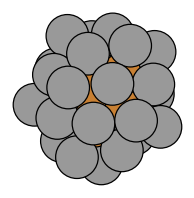
cl_Ag27Cu7
-92.589 eV
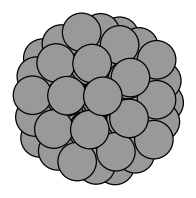
cl_Ag55
-143.904 eV
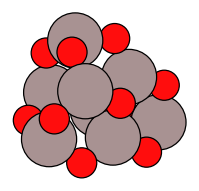
cl_Al8O12
-131.450 eV
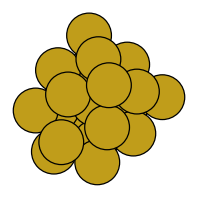
cl_Au20
-54.218 eV
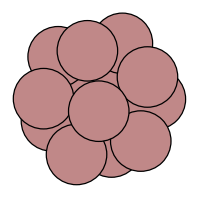
cl_B12
-70.329 eV
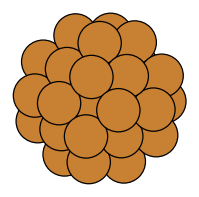
cl_Cu38
-124.470 eV
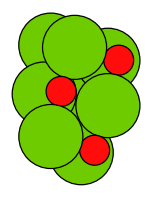
cl_Mg8O8
-79.108 eV
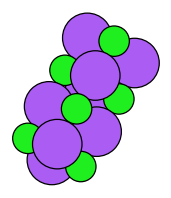
cl_Na8Cl8
-46.392 eV
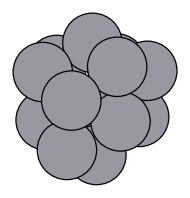
cl_Pt13
-60.512 eV
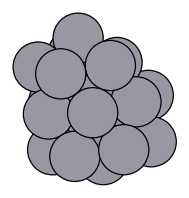
cl_Pt19
-93.654 eV
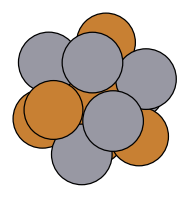
cl_Pt7Cu6
-51.243 eV
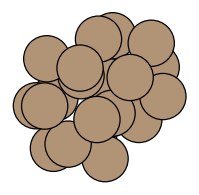
cl_Si20
-97.221 eV
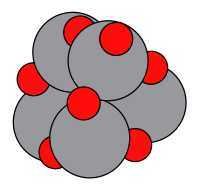
cl_Ti6O12
-153.068 eV
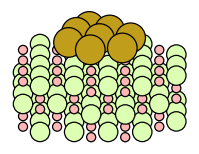
su_Au8_MgO100
-1304.467 eV
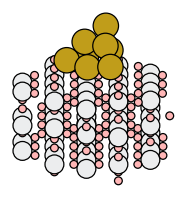
su_Au8_TiO2_110
-2917.709 eV
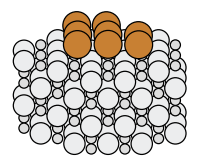
su_Cu8_TiC001
-1896.129 eV
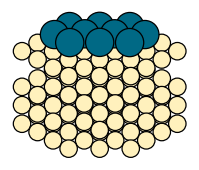
su_Pd10_Au111
-750.295 eV
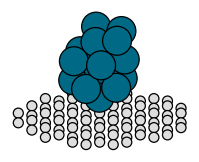
su_Pd16_graphene
-1253.069 eV
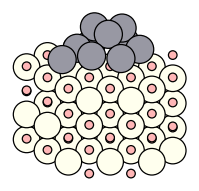
su_Pt10_CeO2_111
-2015.337 eV
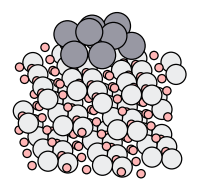
su_Pt10_TiO2a101
-1996.772 eV
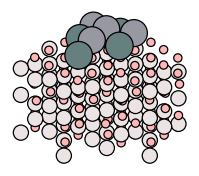
su_Pt4Sn4_Al2O3
-1796.864 eV
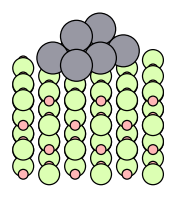
su_Pt8_MgO100
-903.441 eV
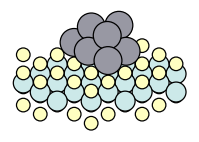
su_Pt8_MoS2
-853.724 eV
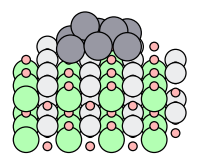
su_Pt8_SrTiO3_100
-1306.264 eV
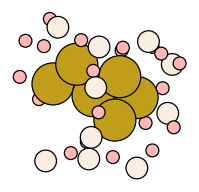
ze_Au6_MFI
-2275.943 eV
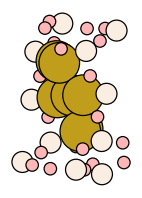
ze_Au7_BEA
-1525.042 eV
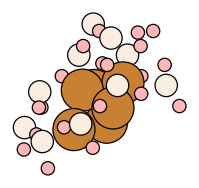
ze_Cu6_AEI
-1151.465 eV
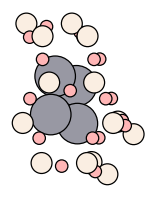
ze_Pt4_CHA
-868.009 eV
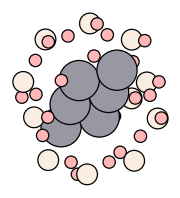
ze_Pt6_TON
-1726.858 eV
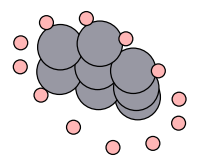
ze_Pt8_FAU
-1174.364 eV
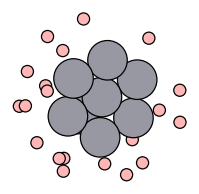
ze_Pt8_MWW
-1735.795 eV
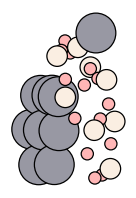
ze_Pt9_LTA
-1175.253 eV
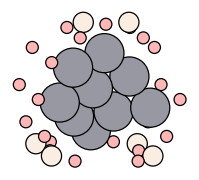
ze_Pt9_MOR
-1173.951 eV
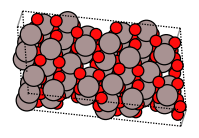
bu_Al8O12
-152.733 eV
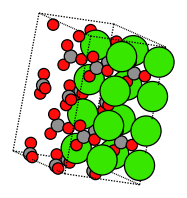
bu_Ca2C2O6
-75.385 eV
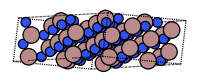
bu_Ga6N6
-73.423 eV
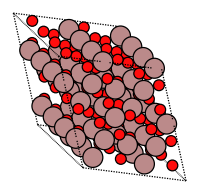
bu_Ga8O12
-122.997 eV
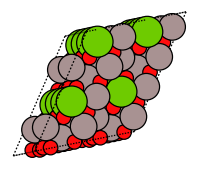
bu_Mg2Al4O8
-101.208 eV
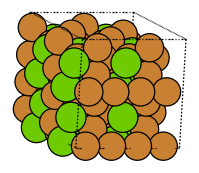
bu_Mg4Cu8
-43.194 eV
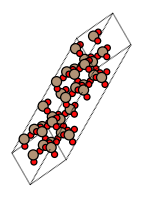
bu_Si4O8
-94.588 eV
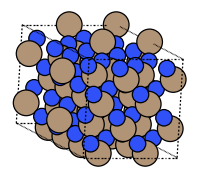
bu_Si6N8
-117.299 eV
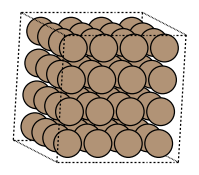
bu_Si8
-44.116 eV
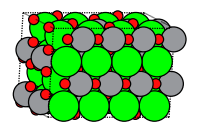
bu_Sr4Ti4O12
-163.984 eV
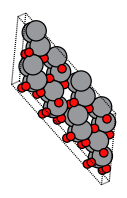
bu_Ti4O8
-109.891 eV
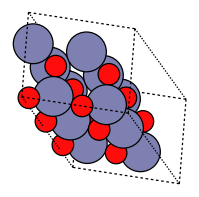
bu_Zn12O12
-106.397 eV
成功率随离子步变化
气相团簇
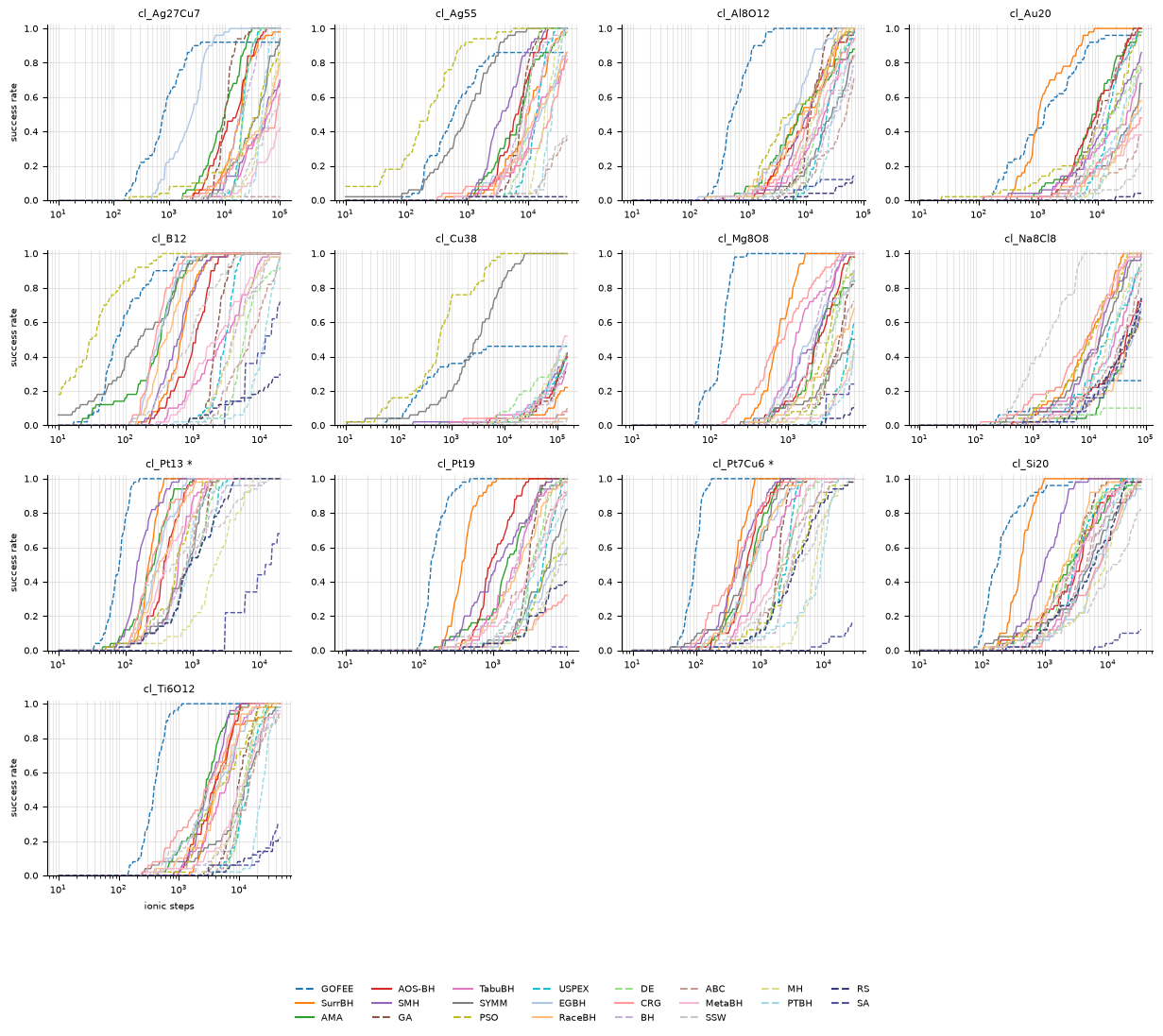
表面负载团簇
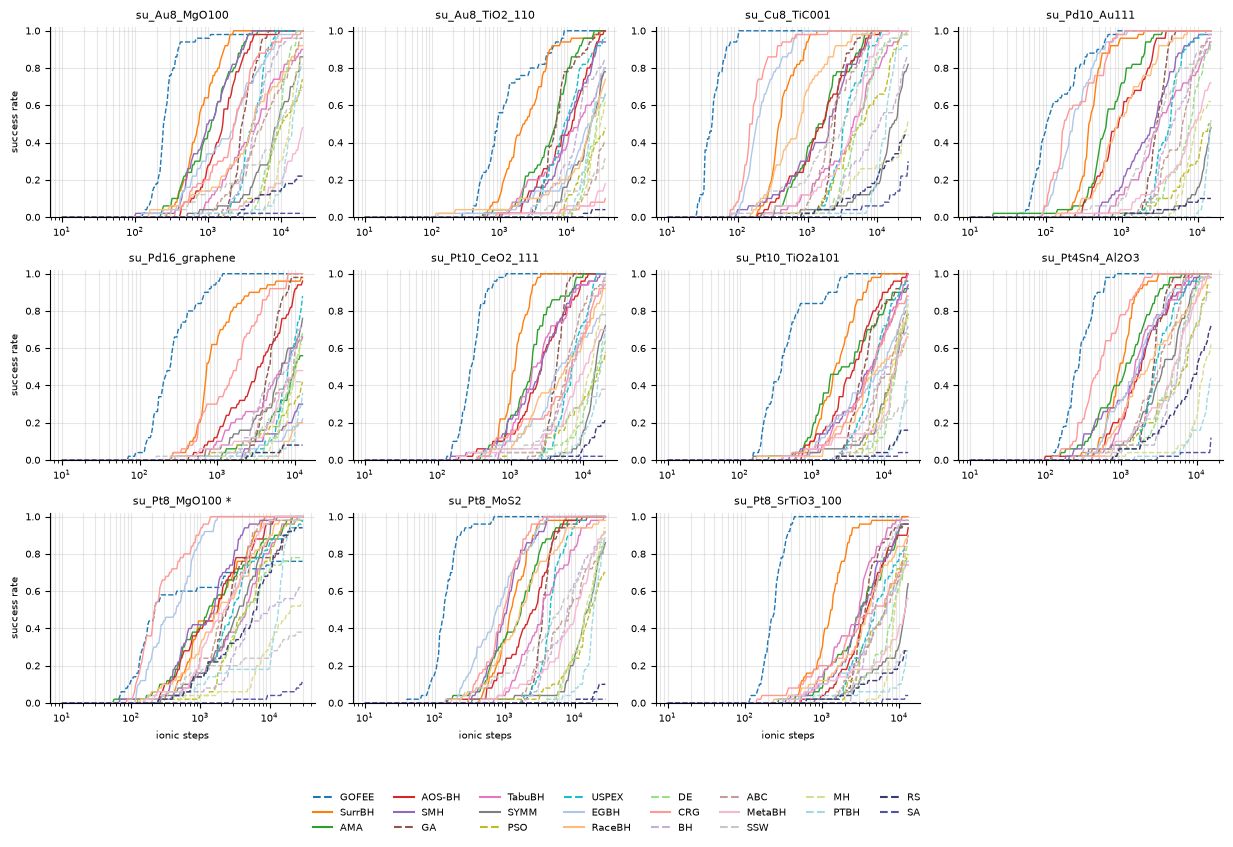
分子筛内金属团簇
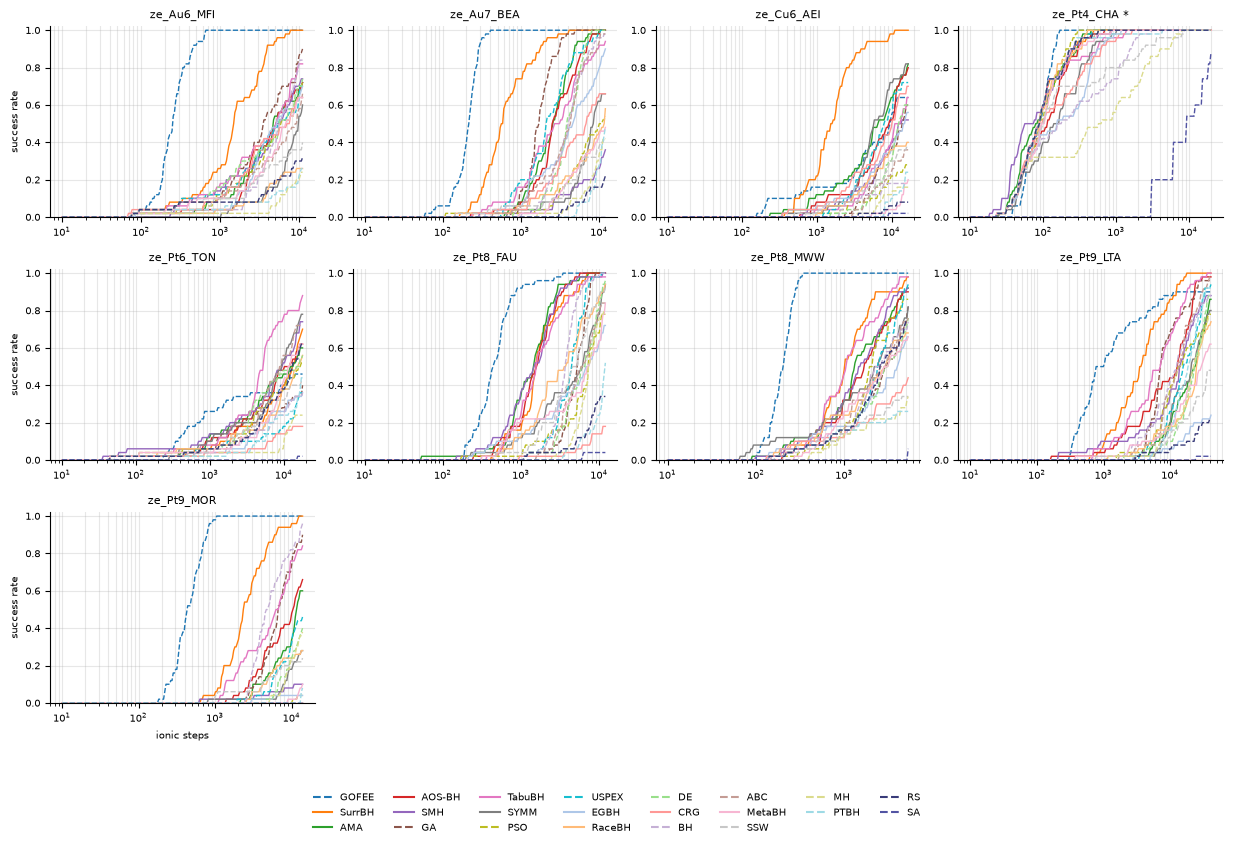
体相晶体
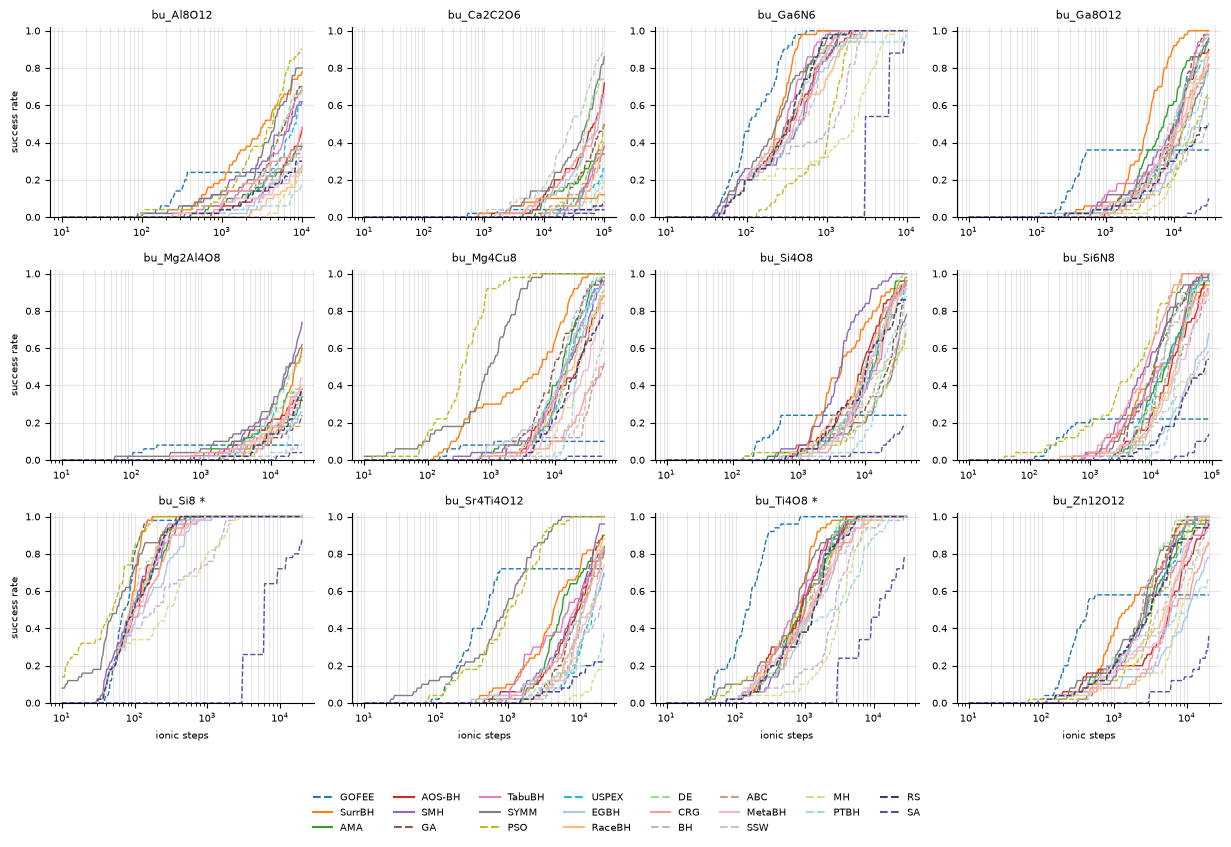
算法
| 算法 | 代号 | 类型 | 描述 | 参考文献 |
|---|---|---|---|---|
| Artificial bee colony (ABCluster) | abc | 主流 | 人工蜂群算法:以 SN=10 个经局部弛豫的结构作为“蜜源”进行群体智能搜索。每一轮中,雇佣蜂为每个蜜源生成一个邻域解:将随机选取的一部分原子(体相还包括晶格)沿该蜜源与另一个经过对齐的蜜源之差移动,v = x_i + φ(x_i − x_k),φ∈[−1,1],局部弛豫后仅当能量更低时才替换原蜜源;观察蜂按适应度成比例地选择蜜源重复该操作;侦察蜂把连续 limit=3 轮未改进的蜜源替换为新的随机弛豫结构。这是 Karaboga 与 Basturk 提出、并由 ABCluster 推广到团簇的标准方法;此处仅增加了差分前按元素的匈牙利/Procrustes 结构对齐、可变晶胞体相中对分数坐标和晶格矢量的同时操作,以及把被移动穿过周期性真空层、移向基底下表面的负载团簇原子重新放回团簇上。 | D. Karaboga & B. Basturk, J. Glob. Optim. 39, 459 (2007); J. Zhang & M. Dolg, Phys. Chem. Chem. Phys. 17, 24173 (2015) (ABCluster) |
| Basin hopping | bh | 主流 | 采用 GMIN 标准设置的蒙特卡洛极小化(盆地跳跃):在弛豫后的能量面上进行 kT = 0.1 eV 的 Metropolis 行走。每次移动把所有搜索原子在半径为 step 的球内均匀随机位移(体相再加 σ = 0.05 的随机对称晶胞应变),用 L-BFGS 弛豫,并以 min(1, exp(−ΔE/kT)) 的概率接受。每 10 次移动根据这 10 次移动的接受率是否高于 50% 将步长乘以 1.1 或 0.9(限制在 0.1–2 Å,初值 0.5 Å);团簇中脱离的原子被重新放回团簇表面。采用文献参数,未调参。 | Li & Scheraga, PNAS 84, 6611 (1987); Wales & Doye, J. Phys. Chem. A 101, 5111 (1997) |
| Differential evolution | de | 主流 | 经典的 DE/rand/1/bin 差分进化(Storn & Price),种群由 20 个经过局部弛豫的结构组成(拉马克式,与团簇优化程序 PDECO 相同):对每个目标个体,用另外三个随机个体构造变异向量 a + F(b - c)(F = 0.5),再以原子为单位与目标个体做二项交叉(CR = 0.9;体相晶体的晶胞作为额外一个基因),弛豫后只有当能量更低且与其他个体不重复时才替换目标个体。由于同种原子可以互换,构造差分向量前先按元素用匈牙利算法匹配原子;气相团簇另做 Kabsch 旋转对齐,负载团簇和分子筛内团簇只做晶格平移,体相则使用约化晶胞中的分数坐标。这是一个标准基线方法,只为原子体系补充了对齐、去重和约束修复。 | R. Storn & K. Price, J. Glob. Optim. 11, 341 (1997); Z. Chen, X. Jiang, J. Li, S. Li & L. Wang, J. Comput. Chem. 34, 1046 (2013) (PDECO); Y.-Y. Zhang, W. Gao, S. Chen, H. Xiang & X.-G. Gong, Comput. Mater. Sci. 98, 51 (2015) (IM2ODE) |
| GOFEE (Gaussian-process surrogate search) | gofee | 主流 | GOFEE 用迄今得到的所有 NEP 能量训练一个高斯过程代理模型(基于径向+角度分布指纹的双高斯核,并带排斥先验)。每次迭代从 10 个低能结构组成的种群中生成 30 个候选结构(随机结构、扰动、切割拼接、元素置换),在代理模型的置信下界 mu - 2 sigma 上免费弛豫,只对最有希望的一个结构花费真实离子步(一次单点计算加一个沿受力方向的“对偶点”)。这是 Bisbo 与 Hammer 发表的标准方法;唯一的补充是偶尔对种群中能量最低且尚未弛豫的结构做一次简短的真实 NEP 弛豫(因为命中要求能量在真实 NEP 极小值 0.02 eV 以内),以及为控制墙钟时间而对训练集大小和代理弛豫步数设的上限。 | M. K. Bisbo and B. Hammer, Phys. Rev. Lett. 124, 086102 (2020); M. K. Bisbo and B. Hammer, Phys. Rev. B 105, 245404 (2022) |
| Genetic algorithm (cut-and-splice) | ga | 主流 | 标准拉马克式团簇遗传算法(Deaven-Ho 剪切拼接、伯明翰团簇遗传算法 BCGA 与 ASE-GA)的忠实基线实现,采用文献标准参数:由 20 个经局部弛豫的结构组成的种群以稳态方式进化,父代通过轮盘赌选择,适应度为 Johnston 的归一化能量 tanh 函数(并带有 ASE-GA 的配对次数与重复结构惩罚)。子代由 Deaven-Ho 剪切拼接交叉产生(负载团簇采用垂直于表面的切面并保持吸附位点对齐;体相采用 Abraham-Probert 在分数坐标下的周期性切割并继承加权平均的晶格),或以 0.2 的概率由标准变异产生(随机扰动、镜像、半团簇扭转、原子重定位、异种原子置换;体相另有晶胞应变)。每个子代都用 L-BFGS 局部弛豫,若能量低于种群中最差个体且不与已有结构重复(能量加指纹判据)则将其替换;若连续 10 代(200 个候选结构)未找到更优结构,则以新的随机种群重新开始。 | D. M. Deaven & K. M. Ho, Phys. Rev. Lett. 75, 288 (1995); R. L. Johnston, Dalton Trans. 2003, 4193 (Birmingham Cluster GA); L. B. Vilhelmsen & B. Hammer, J. Chem. Phys. 141, 044711 (2014) (ASE-GA); N. L. Abraham & M. I. J. Probert, Phys. Rev. B 73, 224104 (2006) (periodic cut for crystals) |
| Minima hopping | mh | 主流 | 极小跳跃法(Goedecker 2004):从当前局部极小出发,以温度 T 下的麦克斯韦-玻尔兹曼速度进行一段短的分子动力学模拟以越过势垒,在轨迹上遇到第二个势能极小时停止,再用 L-BFGS 弛豫;若落回同一个或已访问过的极小则升高 T(×1.1),找到新极小则降低 T(÷1.1);与当前不同的极小只要能量比当前高出不到 Ediff 就被接受,Ediff 自适应调整(接受时 ×0.98,拒绝时 ÷0.98),使大约一半的极小被接受。与 Goedecker 课题组后来的版本一样,初始速度先经过最多 20 次只用梯度的二聚体迭代向低曲率方向软化(Schönborn 等 2009),MD 时间步长根据能量守恒情况自适应调整;体相晶体采用晶格矢量也随之运动的可变晶胞逃逸动力学(Amsler & Goedecker 2010),随后进行可变晶胞弛豫并对晶胞做 Minkowski 约化。这是采用 ASE/文献默认参数(T0 = 1000 K、Ediff0 = 0.5 eV、mdmin = 2)的忠实基线实现,仅加入了安全措施:破坏能量守恒或把晶胞压扁的逃逸会被提前终止并视为过热(降低 T),脱离团簇或吸附物的原子在弛豫前被放回原处。 | S. Goedecker, J. Chem. Phys. 120, 9911 (2004) (minima hopping); S. E. Schoenborn, S. Goedecker, S. Roy & A. R. Oganov, J. Chem. Phys. 130, 144108 (2009) (softening); M. Amsler & S. Goedecker, J. Chem. Phys. 133, 224104 (2010) (variable-cell minima hopping); A. A. Peterson, Top. Catal. 57, 40 (2014) (ASE MinimaHopping, default parameters); M. Krummenacher et al., SoftwareX 25, 101632 (2024) (minimahopping reference code: time-step feedback, softening details) |
| Parallel-tempering basin hopping | ptbh | 主流 | 基于并行回火的盆地跳跃(BHPT,又称副本交换盆地跳跃):六个标准盆地跳跃行走者(与 BH 基线相同的移动方式、L-BFGS 局部弛豫和自适应步长)分别处于 kT = 0.05–0.5 eV 的固定几何温度阶梯上,共享同一个离子步预算,轮流各走一步。每轮结束后以 0.5 的概率让相邻温度的副本按副本交换判据 min(1, exp[(1/kT_i − 1/kT_j)(E_i − E_j)]) 交换各自当前的局部极小,使高温副本自由探索时发现的低能极小逐步传递到低温副本中进一步精修。这是 Strodel 等人提出的标准方法(GMIN 关键字 BHPT),采用文献中的参数值;唯一的改动是各副本在单进程中交替运行并共享预算、每个温度的步长根据最近 10 次移动的接受率自适应调整,以及对变胞体相在每次晶胞应变移动前做 Minkowski 晶格约化、并在晶胞弛豫中止时让该副本从新的随机结构重新开始。 | Strodel, Lee, Whittleston & Wales, J. Am. Chem. Soc. 132, 13300 (2010) (basin-hopping parallel tempering, GMIN keyword BHPT); Wales & Doye, J. Phys. Chem. A 101, 5111 (1997) (basin hopping); Swendsen & Wang, Phys. Rev. Lett. 57, 2607 (1986) and Hukushima & Nemoto, J. Phys. Soc. Jpn. 65, 1604 (1996) (replica exchange / parallel tempering) |
| Particle swarm optimisation (CALYPSO) | pso | 主流 | CALYPSO 风格的粒子群优化:由 20-30 个局部弛豫结构组成的粒子群按 PSO 速度更新公式移动,趋向每个粒子的个体最优和其在指纹空间中最近邻粒子的最优结构(局部 PSO,惯性权重由 0.9 线性降至 0.4,c1 = c2 = 2,速度限幅),每一代另有 40% 为新的随机结构。与 CALYPSO 一致,随机晶体按空间群对称性生成,随机气相团簇按点群对称性生成,借助指纹相似性判据剔除近似重复的结构,连续 10 代全局最优不再改进时重启粒子群。唯一的补充是针对可置换原子的对齐步骤:每次速度更新前按元素做匈牙利算法匹配,自由团簇还额外做 Kabsch 旋转对齐。 | Y. Wang, J. Lv, L. Zhu, Y. Ma, Phys. Rev. B 82, 094116 (2010); Y. Wang, J. Lv, L. Zhu, Y. Ma, Comput. Phys. Commun. 183, 2063 (2012); J. Lv, Y. Wang, L. Zhu, Y. Ma, J. Chem. Phys. 137, 084104 (2012); Y. Wang et al., J. Phys.: Condens. Matter 27, 203203 (2015) |
| Random search | rs | 主流 | 仿照 AIRSS(从头随机结构搜索)的随机采样:在搜索区域内按统一的最小原子间距与连通性约束独立生成随机结构(体相同时随机生成晶胞),每个结构用 L-BFGS 弛豫。各次试验之间没有记忆,因此其效率就是每个离子步落入全局最优盆地的概率;它是衡量搜索策略相对纯随机采样收益的参照。 | Pickard & Needs, J. Phys.: Condens. Matter 23, 053201 (2011) |
| Simulated annealing (MD) | sa | 主流 | 经典的分子动力学模拟退火:每个循环从一个新的随机结构出发,用朗之万恒温器加热到 2500 K,并在 3000 个 MD 步内(时间步长 2 fs,轻元素相应缩短)按几何级数降温到 300 K,随后用 L-BFGS 淬火到最近的局部极小;各循环相互独立,重复进行直到预算用完。体相晶体在零压下用 Berendsen 恒压器退火,并以可变晶胞弛豫淬火。该方法没有新的改动,是采用文献标准参数的忠实基线实现;仅加入了安全措施(把蒸发出去的碎片拉回团簇的弹性容器、防止 MD 发散的速度上限),并把最后一次退火缩短以适应剩余预算。 | S. Kirkpatrick, C. D. Gelatt & M. P. Vecchi, Science 220, 671 (1983); R. Biswas & D. R. Hamann, Phys. Rev. B 34, 895 (1986) (MD annealing of Si clusters); H. J. C. Berendsen et al., J. Chem. Phys. 81, 3684 (1984) (barostat); B. Leimkuhler & C. Matthews, Appl. Math. Res. Express 2013, 34 (BAOAB Langevin integrator) |
| Stochastic surface walking | ssw | 主流 | 在局域极小之间进行 Metropolis 蒙特卡洛行走,每一次试探移动都从当前势阱中平滑地“爬出”:沿一个随机方向(用偏置二聚体旋转向低曲率的软模修正)逐个加入高斯偏置势(宽度 0.6 Å,每步最多 10 个),每加一个就在偏置势能面上做局域弛豫,最后去掉全部偏置势并完全弛豫到新的极小,再按 1000 K 的 Metropolis 准则接受或拒绝。这是采用文献参数的标准 SSW 方法(Shang 和 Liu),晶体按 LASP 的方式把原子和晶格自由度放在同一组广义坐标中;二聚体旋转、爬坡和弛豫中的每一次力计算都计为一个离子步。 | C. Shang, Z.-P. Liu, J. Chem. Theory Comput. 9, 1838 (2013) (SSW); C. Shang, Z.-P. Liu, J. Chem. Theory Comput. 8, 2215 (2012) (BP-CBD biased dimer rotation/translation); X.-J. Zhang, C. Shang, Z.-P. Liu, J. Chem. Theory Comput. 9, 3252 (2013); C. Shang, X.-J. Zhang, Z.-P. Liu, Phys. Chem. Chem. Phys. 16, 17845 (2014) (SSW-crystal); S.-D. Huang, C. Shang, P.-L. Kang, X.-J. Zhang, Z.-P. Liu, WIREs Comput. Mol. Sci. 9, e1415 (2019) (LASP) |
| USPEX evolutionary algorithm | uspex | 主流 | USPEX 风格的代际进化算法:由 10-30 个(搜索原子数的 2 倍)经局部弛豫的结构组成种群,通过以下算子产生下一代:空间遗传(约 50%,用随机平面或晶体切片切分两个按能量排序选出的父代并拼接,晶体的晶格取两者的随机加权平均)、随机新结构(约 20%)、沿键硬度弹簧模型最软振动模式的软模突变(约 20%)、不同元素原子交换(多元素体系)以及随机晶格应变(体相)。不重复结构中能量最低的 60% 作为父代,最好的 15% 直接保留到下一代;晶体用 Oganov-Valle 指纹、团簇用距离指纹剔除重复结构。这是采用 USPEX 默认算子比例和参数值的标准基线方法。若最优结构连续 n_search 代没有改进,搜索重新开始。 | A. R. Oganov & C. W. Glass, J. Chem. Phys. 124, 244704 (2006); A. O. Lyakhov, A. R. Oganov, H. T. Stokes & Q. Zhu, Comput. Phys. Commun. 184, 1172 (2013); A. O. Lyakhov, A. R. Oganov & M. Valle, Comput. Phys. Commun. 181, 1623 (2010); A. O. Lyakhov & A. R. Oganov, Phys. Rev. B 84, 092103 (2011); A. R. Oganov & M. Valle, J. Chem. Phys. 130, 104504 (2009); Q. Zhu, L. Li, A. R. Oganov & P. B. Allen, Phys. Rev. B 87, 195317 (2013) |
| Adaptive memetic algorithm (GA + BH chains) | memetic | 创新 | 自适应模因算法:一个小规模、带小生境的已弛豫结构种群(仅以两个随机结构起步,其余由子代填充)由三种相互竞争的算子演化:Deaven-Ho 剪切拼接交叉(表面体系保持吸附位点配准)或晶格遗传(体相);从优良且尚未“耗尽”的个体出发、可自行终止的短程 Metropolis 盆地跳跃链;以及新的随机结构,其中一半在成键良好的位点上逐原子生长得到。离子步预算通过信用分配在线分给各算子:只有产生“已见极小值档案”中没有的新极小值时,算子才获得基于排名的奖励,并按其带遗忘的“每离子步奖励”成比例地被选中,因此搜索会根据当前哪种策略更有效而表现为遗传算法、盆地跳跃或随机搜索。第二层(元拉马克式)信用分配选择盆地跳跃的移动类型:自适应扰动、扭转、刚性移动、晶格应变、异种原子交换(4 次试交换中取未弛豫能量最低者),或把能量最高的原子迁移到 48 个候选位点中成键最好的位置——在载体上或孔道内,候选位点也包括基底原子旁的位置,使原子可以铺展到载体上。指纹小生境和停滞后的精英保留式移民维持种群多样性。 | P. Moscato, Caltech C3P Report 826 (1989); Y.-S. Ong & A. J. Keane, IEEE Trans. Evol. Comput. 8, 99 (2004); D. M. Deaven & K. M. Ho, Phys. Rev. Lett. 75, 288 (1995); A. R. Oganov & C. W. Glass, J. Chem. Phys. 124, 244704 (2006); D. J. Wales & J. P. K. Doye, J. Phys. Chem. A 101, 5111 (1997) |
| Adaptive operator selection basin hopping | aosbh | 创新 | 在基跳(basin hopping)框架中,由在线多臂老虎机算法为每一步从一组按体系类别配置的结构算子中选择移动方式:全局与局部随机扰动、将结合最弱的原子(按 NEP 原子能量排序)迁移到配位最高的空位,对负载团簇还可迁移到团簇顶部的顶位(把润湿载体的二维筏状结构变为三维岛)、团簇扭转、载体或孔道中团簇的刚体移动、异种原子交换、晶胞应变、与存档低能结构的切割拼接以及全新的随机结构。该老虎机(带折扣并计入离子步代价的 Thompson 采样)按每个离子步的成功率(新的全局最优、新的低能极小、下坡跳跃)为各算子记功,从而无需针对具体体系调参即可自动把计算量转向在当前体系上有效的移动。移动幅度与 Metropolis 温度在线自适应;利用经校准的能量尾部预测器提前终止无法进入 Metropolis 接受范围的弛豫;搜索停滞时从随机结构或扰动后的存档极小重新开始。 | Wales & Doye, J. Phys. Chem. A 101, 5111 (1997); Fialho, Da Costa, Schoenauer & Sebag, Ann. Math. Artif. Intell. 60, 25 (2010); Thierens, GECCO 2005, 1539; Xia et al., IJCAI 2015; Raj & Kalyani, arXiv:1707.09727 (2017); Deaven & Ho, Phys. Rev. Lett. 75, 288 (1995); Rondina & Da Silva, J. Chem. Inf. Model. 53, 2282 (2013) |
| Cut-and-regrow (learned-site growth) | growth | 创新 | 在弛豫后的局部极小之间进行 Metropolis 随机行走,唯一的结构移动是“切除-再生长”:先移除 k 个原子(NEP 单原子能量最高的原子、随机的空间连续片段或配位数最低的原子),再将它们逐个重新生长到几何枚举的空位(三原子穴位、桥位、顶位)上——位置可以在剩余团簇上、载体或分子筛孔壁上,或在周期性晶胞内(体相同时施加随机晶胞应变;合金/化合物另加按能量引导的元素交换)。创新之处:候选位点由一个按元素区分的岭回归模型排序,该模型拟合 NEP 单原子能量,并利用每次弛豫起点和终点的数据在线更新,不消耗额外离子步;停滞时切除数 k 自适应增大至约 n/3,之后随机重启;每次局部弛豫分两阶段进行,只有当试探结构仍可能通过预先抽取的 Metropolis 阈值时才弛豫到完全收敛。 | Wales & Doye, J. Phys. Chem. A 101, 5111 (1997) (basin hopping); Shao, Cheng & Cai, J. Chem. Phys. 120, 11401 (2004) (dynamic lattice searching); Rondina & Da Silva, J. Chem. Inf. Model. 53, 2282 (2013) (revised basin hopping); Deaven & Ho, Phys. Rev. Lett. 75, 288 (1995) (cut-and-splice); Northby, J. Chem. Phys. 87, 6166 (1987) and Takeuchi, J. Chem. Inf. Model. 46, 2066 (2006) (cluster growth sequences); Pickard & Needs, J. Phys.: Condens. Matter 23, 053201 (2011) (AIRSS random restarts) |
| Energy-guided basin hopping | egbh | 创新 | 能量引导盆地跳跃(EGBH)是一种盆地跳跃随机游走,其移动由 NEP89 每次计算时免费给出的单原子能量引导。弱束缚原子(位点能量相对于同种元素偏高)被优先移动到动态晶格候选位点(团簇、载体或晶体上键合三角形上方的顶点位、桥位和顶位),这些位点由一个在线学习、按元素区分的位点能量模型排序,该模型直接从势函数自身的能量分解中学习;合金和化合物还使用模型引导的异种原子交换,以及用单点能量对当前极小结构的所有交换进行排序的交换扫描。禁忌表、能量加权扰动、扭转、刚体移动、晶胞应变和全新随机结构保证搜索的多样性,各类移动的概率根据其每个离子步带来的能量收益在线自适应调整。与标准盆地跳跃和动态晶格搜索相比,其创新之处在于用机器学习势的位点能量同时决定移动哪些原子,并通过所学模型判断每种元素的原子倾向于占据哪些位置。 | Wales & Doye, J. Phys. Chem. A 101, 5111 (1997) [basin hopping]; Shao, Cheng & Cai, J. Comput. Chem. 25, 1693 (2004) [dynamic lattice searching]; Takeuchi, J. Chem. Inf. Model. 46, 2066 (2006) [moving the highest-energy atoms to the best surface sites]; Rossi & Ferrando, J. Phys.: Condens. Matter 21, 084208 (2009) [exchange moves for nanoalloys]; Behler & Parrinello, PRL 98, 146401 (2007) [atom-centred radial descriptors]; Glover, ORSA J. Comput. 1, 190 (1989) [tabu search] |
| Metadynamics-biased basin hopping | metabh | 创新 | 在盆地跳跃(basin hopping)的 Metropolis 判据中用 E + V(s) 代替 E:s 是每个局部极小结构的与能量无关的结构描述符(按元素对的配位数、Steinhardt q4/q6、团簇的尺寸与形状、负载团簇与基底的接触及高度、晶体的每原子体积),V 是在已访问极小处沉积宽高斯函数(每个覆盖由相似极小构成的整个漏斗)构成的 well-tempered 元动力学偏置势,从而逐步填平游走者长时间停留的结构区域,把它推向尚未探索的结构类型,而最优结构仍只由真实的 NEP 能量决定。移动包括步长自适应的随机位移、把单原子能量高的原子移到配位良好的空位(hollow site)、异种原子交换、负载或限域团簇的刚性移动以及偶尔的随机结构跳跃;当在线标定的剩余能量下降估计表明某次试探弛豫已不可能通过预先抽取的 Metropolis 阈值时,提前终止该弛豫。创新之处在于把自由能计算中作用于集体变量的元动力学历史依赖偏置引入到盆地跳跃在极小之间的离散游走中。 | Laio & Parrinello, PNAS 99, 12562 (2002); Barducci, Bussi & Parrinello, PRL 100, 020603 (2008); Iwamatsu & Okabe, Chem. Phys. Lett. 399, 396 (2004); Wales & Doye, J. Phys. Chem. A 101, 5111 (1997); Steinhardt, Nelson & Ronchetti, PRB 28, 784 (1983); cf. energy-landscape paving, Hansmann & Wille, PRL 88, 068105 (2002) |
| Online-surrogate pre-relaxation BH | surr | 创新 | 在基跳(basin hopping)框架中在线拟合一个廉价的代理势(线性矩张量/类MEAM的原子能量模型,冻结的基底原子作为近邻参与描述),用岭回归拟合本次运行中每一个NEP离子步的能量、力和维里,不使用任何预训练数据。每个循环先在代理势上免费弛豫一批候选结构(扰动、原子重定位、交叉、元素互换、随机结构),用指纹剔除落回已访问能谷的候选以及落入模型“空洞”的候选,只把预测能量最低的新极小值交给NEP弛豫。创新点:NEP弛豫本身采用“代理牛顿”步——每个离子步都跳到经当前NEP能量和力校正后的代理势在信赖域内的极小点(体相同时优化晶胞),因此每个极小值只需少量离子步而不是数十步;筛选步长按代理势上的逃逸能谷比例自适应,当在线测得的代理误差过大或墙钟时间调控器触发时,自动退回不经筛选的普通移动。 | Wales & Doye, J. Phys. Chem. A 101, 5111 (1997) [basin hopping]; Shapeev, Multiscale Model. Simul. 14, 1153 (2016) [moment tensor potentials]; Baskes, Phys. Rev. B 46, 2727 (1992) [MEAM angular densities]; Jacobsen, Jorgensen & Hammer, Phys. Rev. Lett. 120, 026102 (2018) [on-the-fly learned structure search]; Kolsbjerg, Peterson & Hammer, Phys. Rev. B 97, 195424 (2018) [NN-accelerated global optimisation]; Podryabinkin, Tikhonov, Shapeev & Oganov, Phys. Rev. B 99, 064114 (2019) [MLIP pre-relaxation in crystal structure prediction]; del Rio, Mortensen & Jacobsen, Phys. Rev. B 100, 104103 (2019) [GPMin surrogate-accelerated local optimisation]; Bisbo & Hammer, Phys. Rev. Lett. 124, 086102 (2020) [GOFEE, contrasted] |
| Racing basin hopping | race | 创新 | 一种盆地跳跃(basin hopping)方法,其中每一次局部弛豫都与 Metropolis 接受阈值进行“竞速”:Metropolis 判据所用的随机数在弛豫开始之前就已抽取,L-BFGS 弛豫则逐步推进、每次只走一步迭代。一旦最终能量的乐观下界表明该试探无论如何都会被拒绝,弛豫就立即中止;如果试探必然被接受、但不可能成为新的全局最优,则在较宽松的力收敛阈值处提前停止。该下界通过保形预测(conformal prediction)在线校准,随机重启与局部移动各自单独校准:随机抽取 10% 的试探做完整弛豫作为校准样本,因此无论体系的能量尺度如何,错误中止的概率都不超过 10%。在必败试探上节省下来的步数被用于更大胆的移动:在高配位空位处“切除再生长”高能原子、交换不同元素原子、对负载团簇做刚性平移转动,以及参与竞速的随机重启。 | Wales & Doye, J. Phys. Chem. A 101, 5111 (1997); Maron & Moore, NIPS 6 (1994) and Artif. Intell. Rev. 11, 193 (1997); Jamieson & Talwalkar, AISTATS (2016); Li et al., JMLR 18, 1 (2018); Vovk, Gammerman & Shafer, Algorithmic Learning in a Random World, Springer (2005); Iwamatsu & Okabe, Chem. Phys. Lett. 399, 396 (2004); Shao, Cheng & Cai, J. Comput. Chem. 25, 1693 (2004) |
| Soft-mode guided hopping | softmode | 创新 | 一种盆地跳跃(basin hopping)方法:试探步不再随机扰动所有原子,而是沿当前极小结构最软的集体振动模式移动。这些模式不消耗任何能量计算:它们来自由共价半径构建的键刚度模型 Hessian(指数型原子对弹簧;衬底原子作为锚点,体相晶体额外包含六个晶胞应变分量),同一模型 Hessian 还用作 L-BFGS 局部弛豫的预条件子。跳跃幅度在线自适应,使 65% 的跳跃逃逸到新的盆地;合金体系额外使用概率自调节的异种原子交换,并保留盆地跳跃的 Metropolis 接受准则和停滞后从随机结构重启。其新颖之处在于:使用零代价的模型 Hessian 软模(代替 USPEX 软模突变或极小跳跃中代价高昂的真实 Hessian 软化),并结合逃逸率控制和模型 Hessian 预条件。 | A. O. Lyakhov, A. R. Oganov & M. Valle, Comput. Phys. Commun. 181, 1623 (2010) [softmutation]; M. Schoenborn, S. Goedecker, S. Roy & A. R. Oganov, J. Chem. Phys. 130, 144108 (2009) [minima-hopping softening]; G. Henkelman & H. Jonsson, J. Chem. Phys. 111, 7010 (1999) [dimer]; R. Lindh et al., Chem. Phys. Lett. 241, 423 (1995) [model Hessian]; D. Packwood et al., J. Chem. Phys. 144, 164109 (2016) [preconditioning]; A. R. Atilgan et al., Biophys. J. 80, 505 (2001) [anisotropic network model]; D. J. Wales & J. P. K. Doye, J. Phys. Chem. A 101, 5111 (1997) [basin hopping] |
| Symmetry-seeded search | symm | 创新 | 对称性播种搜索包含两个分支。探索分支用自编的群论代码生成随机但具有对称性的初始结构:气相团簇随机选取点群,并以精确组成的背包划分填充其各类轨道(中心、旋转轴、镜面与一般位置);负载团簇采用以顶位、桥位或空位为轴心的竖直 Cn/Cnv 点群;分子筛客体团簇在孔道内放置对称结构单元;体相晶体填充 37 个空间群的 Wyckoff 轨道并随机扩胞;对合金和离子型组成,先生成对称“骨架”,再按核壳、随机或电负性差最大化规则分配元素。利用分支是 Metropolis 基跳行走者(自适应步长、晶胞应变、异种原子交换,以及对团簇将结构投影到其检测出的近似点群的“对称化”移动),遇到更优的种子结构时跳转过去,停滞时从新种子重启。带折扣的概率匹配老虎机按每个离子步获得新低能极小的速率,在播种与跳跃之间、以及对称、C1 与普通随机种子之间分配计算量。创新之处在于把 AIRSS/PyXtal/CALYPSO 式的对称随机播种在同一套代码中统一用于团簇、负载团簇、分子筛客体与晶体,并与老虎机平衡的基跳相结合,另加骨架装饰与对称化移动。 | C. J. Pickard & R. J. Needs, J. Phys.: Condens. Matter 23, 053201 (2011) (AIRSS); S. Fredericks, K. Parrish, D. Sayre & Q. Zhu, Comput. Phys. Commun. 261, 107810 (2021) (PyXtal); Y. Wang, J. Lv, L. Zhu & Y. Ma, Phys. Rev. B 82, 094116 (2010) and Comput. Phys. Commun. 183, 2063 (2012) (CALYPSO); D. J. Wales & J. P. K. Doye, J. Phys. Chem. A 101, 5111 (1997) (basin hopping) |
| Tabu basin hopping | tabu | 创新 | 由禁忌记忆引导的盆地跳跃(basin hopping):算法记录已找到的每一个局部极小(按能量分箱的哈希加按元素区分的距离指纹,识别极小无需额外的力计算)。对 E + λ·log(1+访问次数) 做 Metropolis 接受判据并配合短期禁忌表;落回已知极小时增大下一次扰动,反复重访则从随机结构或很少使用的低能存档极小重新开始,即将收敛到已知极小的弛豫会被提前终止。团簇移动按每原子 NEP 能量把结合最弱的原子重新放到表面;新颖之处在于同一份记忆同时控制接受、步长、重启和弛豫成本(禁忌搜索 + 能量景观铺平 + 极小跳跃式反馈)。 | Glover, ORSA J. Comput. 1, 190 (1989) and 2, 4 (1990) [tabu search]; Cvijovic & Klinowski, Science 267, 664 (1995) [taboo search for continuous global optimisation]; Wales & Doye, J. Phys. Chem. A 101, 5111 (1997) [basin hopping]; Hansmann & Wille, Phys. Rev. Lett. 88, 068105 (2002) [energy landscape paving]; Goedecker, J. Chem. Phys. 120, 9911 (2004) [history feedback of minima hopping]; Garivier & Moulines, ALT 2011, LNCS 6925, 174 [discounted UCB bandits]; Shao, Cheng & Cai, J. Comput. Chem. 25, 1693 (2004) and Takeuchi, J. Chem. Inf. Model. 46, 2066 (2006) [surface relocation of high-energy atoms] |
方法
势能面
所有能量与力均由 NEP89 通用势(nep89_20250409)通过 calorine 在 CPU 上计算,并叠加短程排斥 guard:Eg = Σ k/2 (r0 − r)2(r < r0 = f (rcov,i + rcov,j),f = 0.75,k = 20 eV/Å2),只作用于含搜索原子的原子对。NEP89 在极短原子间距处存在非物理的低能区域(例如一种塌缩的 TiO2 相比锐钛矿低 30 eV);guard 消除了这些空洞,并且对所有物理合理结构严格为零(最短的真实键 N≡N、C≡C 约为共价半径和的 0.80 倍)。
主实验之前,对所有基准的推定全局最优做了伪影筛查(重算能量、最短距离、guard 能量、连通性、体积),并用对称性约束随机搜索与粒子群算法额外运行专门搜寻“空洞”。发现空洞的基准只对该基准加强 guard,并确认物理极小值不变:TiO2 与 SrTiO3 晶体 f = 0.80(致密塌缩相),Si3N4 f = 0.90(Si–Si 1.65 Å 塌缩),(Al2O3)4 团簇的 O–O 以及 Si3N4、GaN 晶体的 N–N 设阴离子间下限 r0 = 1.9 Å(NEP89 中含 O–O 或 N≡N 键的状态比物理极小值低最多 28 eV;这些体系中真实的最短阴离子间距 ≥ 2.5 Å),SiO2 晶体的 Si–O 设阳离子–阴离子下限 r0 = 1.45 Å(NEP89 中含 1.30 Å Si=O 键的状态比物理极小值低 0.12 eV;真实 Si–O 键长 ≥ 1.5 Å)。基准说明中列出了这些非默认的 guard 设置。
NEP89 计算在三个方向上都是周期性的,因此在表面基准中,搜索原子可能穿过真空层,吸附到周期镜像中冻结的体相截断底面上(用这种方式找到的 TiO2(110) 上 Au8 结构比最佳顶面结构低 1.4 eV)。因此表面基准中的每个搜索原子都受一个平底势墙 k/2 (z − zw)2 约束,势墙位于真空层中点(约在顶面以上 10 Å,高度按板周期取模)。对顶面上的任何结构势墙严格为零:主实验前保存的 2000 多个表面结构中,搜索原子的最大高度为 8.4 Å;包括主实验在内,全部 14,387 次表面运行的最优结构中没有任何搜索原子触及势墙(最高的原子为 9.6 Å,出现在一个结束时比全局最优高 2.3 eV 的运行中)。气相团簇也做了同样检查:没有低能团簇与其周期镜像相互作用(尺寸 ≤ 12 Å,盒长 24–30 Å)。
主实验结束后,对所有计为命中的已保存最优结构(所有批次共 47,789 个)计算了 guard 与势墙能量。其中 20 个结构中 guard 起作用,全部来自两个留出晶体:它们位于 guard 只使其变浅、但没有消除的 NEP89 空洞中。SiO2(bu_Si4O8)中有 4 次运行(SYMM 1 次、PSO 3 次)停在比最佳无 guard 结构低 0.4–8.3 eV 的结构上,其中有 8 根 1.30 Å 的 Si–O 键(即当初为之引入 1.45 Å 下限的 Si=O 状态的更深形式);SrTiO3(bu_Sr4Ti4O12)中有 6 个算法的 16 次运行停在比它低 0.23 eV 的结构上,其中 Sr–O 键长 1.97 Å、Ti–O 键长 1.80 Å。因此 Eref 定义为 guard 与势墙均不起作用(能量 ≤ 0.01 eV)的已保存结构中的最低能量;对其余 43 个基准,它就是找到的最低能量。若以空洞能量作为 Eref,只有掉进空洞的运行才算命中。这 20 次空洞运行与其他运行同样计分,因为它们的最低能量越过了 Eref + etol(全部 16 次 SrTiO3 运行和 1 次 SiO2 运行在此之前先到达了无 guard 的最低结构)。把它们计为失败不改变任何名次,得分变化不超过 0.1;把这两个基准从得分中去掉只交换 GA 与 SMH(第 5、6 名)。
成本度量:离子步
每一次对整个体系的能量+力计算记为一个离子步——无论它属于局部弛豫、分子动力学、单点筛选还是线搜索。所有算法都通过同一个计算上下文调用势函数,由它统一计数,并在达到预算时终止运行。代理模型的预测不计离子步(其开销体现在墙钟时间中)。
成功与效率
一次运行在其历史最低能量首次进入 Eref + etol(通常 0.02 eV)范围内的离子步记为命中全局最优,Eref 为所有运行在该基准上找到的、guard 与势墙均不起作用的结构中的最低能量(见上文)。期望运行时间 ERT =(各运行命中所用步数之和,未命中则计已用步数)/ 命中次数,即在失败后重启的策略下每发现一次全局最优所需的期望离子步数;因墙钟上限或错误而中止且未命中的运行计全部预算。效率 = 1/ERT。每个算法在每个基准上用相同预算独立运行 50 个随机种子(5,300–150,000 离子步),预算在主实验前根据盆地跳跃与随机搜索的预实验确定。
公平性
- 所有算法使用相同的能量函数、局部弛豫收敛阈值(fmax = 0.05 eV/Å;共用的 L-BFGS 与 FIRE 实现)、随机结构生成器、搜索区域与距离约束;任何算法都不能读取基准名称或已有结果。
- 主流算法采用文献推荐参数,不做调参。
- 创新算法只在 6 个开发基准(标 *)上开发与调参;主排名只使用其余留出基准。
- 有限种子数带来的不确定性通过对运行做 bootstrap 重抽样(1000 次)量化。
局限
- Eref 是 NEP89 势能面上(guard 不起作用的结构中)的推定全局最优,而非 DFT 全局最优。NEP89 的误差可能改变能量排序(例如它预测 β-tin 型 Si8 略低于金刚石结构)。
- 成功率较低时 ERT 噪声较大,请参考置信区间与逐基准矩阵。
- 排名取决于基准组成与预算设置,因此同时给出分类排名。
下载
- data/ranking.json – 排名与全部汇总统计
- data/metrics.csv – 每个基准×算法:成功率、ERT、中位命中步、墙钟时间
- data/runs.csv – 每次运行:命中步、已用步数、最低能量、墙钟时间
- data/gm_structures.extxyz – 所有基准的推定全局最优结构
- https://github.com/JiaaoWANG-ut/nep89-global-opt-benchmark/releases – 所有批次每次运行的原始记录(JSON,含能量轨迹与最优结构)以及冻结清单